
A client asked me this last month while standing next to her gelding, visibly bracing for a lecture.
She’d read a forum thread where someone told her flat out that she was too heavy to ride her own horse. She wasn’t. But the conversation we ended up having was more useful than any single number could have been.
That’s the conversation I want to have here.
How Much Weight Can a Horse Carry?
Most healthy horses can comfortably carry around 20% of their ideal body weight in combined rider, saddle, and tack weight. But 20 percent is a starting point.
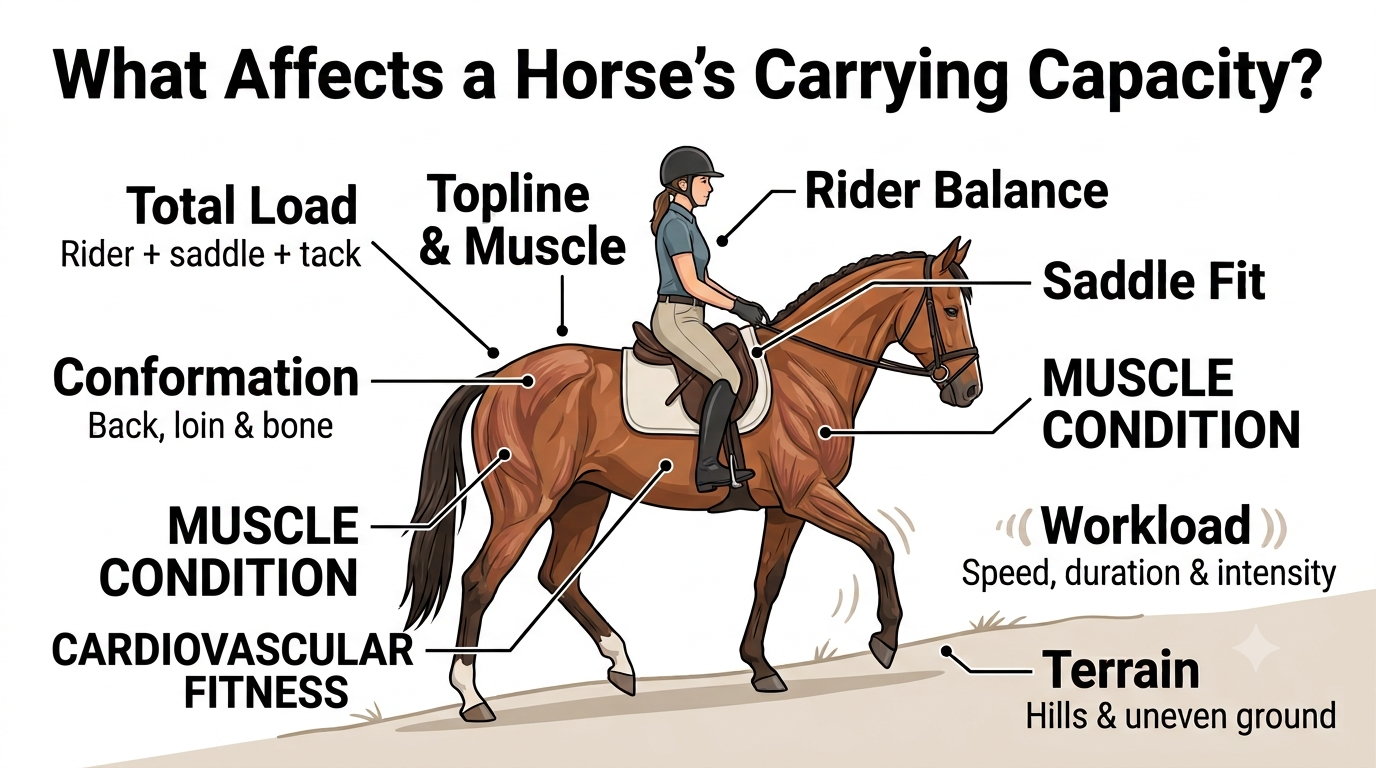
Two horses of the same weight can have very different abilities to comfortably carry a rider and equipment. Conformation, fitness, workload, rider balance, saddle fit, and terrain can all change how comfortably a horse handles a given load.
| Question | Answer |
|---|---|
| How much weight can a horse carry? | Around 20% of ideal body weight as a general guideline |
| Does rider weight include the saddle? | Yes, total load includes rider, saddle, and tack |
| Is 20% a strict rule? | No, it is a starting point, not a guarantee |
| What affects carrying ability? | Breed, build, fitness, age, saddle fit, and type of work |
| How do I know if my horse is struggling? | Look for soreness, resistance, fatigue, or movement changes |
How to apply the 20% guideline
Use this simple calculation:
- Find your horse’s ideal body weight.
- Multiply it by 0.20.
- Remember that number includes the rider, saddle, and tack.
When calculating a horse’s carrying capacity, the 20% guideline includes the entire load, not just the rider. The calculation is:
Rider weight + saddle + tack + equipment ≤ approximately 20% of the horse’s ideal body weight
For example:
- Horse’s ideal weight: 1,100 lb (500 kg)
- Approximate total carrying load (20%): 220 lb (100 kg)
- Rider: 154 lb (70 kg)
- Saddle and tack: 33 lb (15 kg)
- Total load: 187 lb (85 kg)
The total load of 187 lb (85 kg) is below the 220 lb (100 kg) guideline, meaning the rider and equipment are within the commonly used 20% carrying guideline.
The starting point is the horse’s actual body weight. If you’re not sure what a typical horse weighs or how much variation there is between breeds and sizes, see our guide to average horse weight.
What Factors Affect a Horse’s Carrying Capacity?
The 20% guideline is not just a number that has been passed down over time. Research looking at how horses respond to different carried weights, including loads between 15% and 35% of body weight, found that average adult light riding horses generally handled loads around 20% of their ideal body weight better than heavier loads.
When I help horse owners decide what weight is appropriate for their horse, I look beyond the percentage and consider factors such as conformation, fitness, age, health, saddle fit, rider balance, and workload.
| Factor | Why it matters |
|---|---|
| Conformation | Back length, loin strength, bone structure, and overall build can affect how well a horse supports weight |
| Fitness and muscle condition | A conditioned horse with good muscle development and topline strength is generally better prepared for carrying work |
| Rider balance and position | Two riders of the same weight can place different demands on a horse depending on balance and riding position |
| Saddle and tack fit | Poorly fitted equipment can create pressure points and discomfort, even when the total weight is within the guideline |
| Speed and intensity | Faster or more demanding activities increase the physical stress placed on the horse |
| Duration | Longer rides increase cumulative physical demand and require greater conditioning |
| Terrain | Hills, uneven ground, and difficult footing require more effort from the horse |
| Discipline | Different activities, such as jumping, trail riding, or endurance work, place different demands on the horse |
| Age and physical condition | Age, soundness, soreness, and overall health can change a horse’s ability to carry weight comfortably |
| Response to work | Changes in gait, soreness, reluctance, or unusual fatigue may indicate the workload needs reassessment |
Rider Balance Matters, Not Just Rider Weight
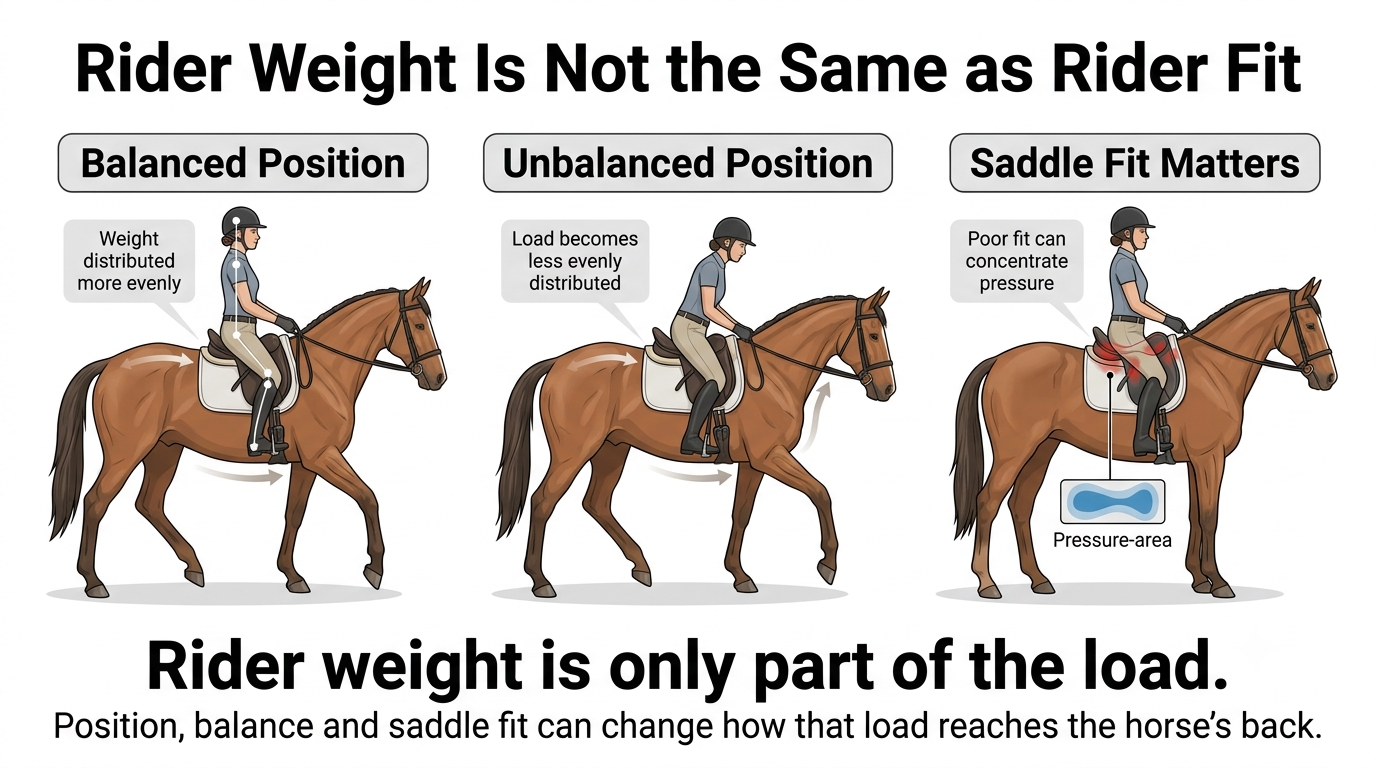
When I help horse owners decide whether a rider’s weight is appropriate, I do not look at the number on the scale alone. How that weight is carried can influence how the horse responds.
Rider balance and position
Two riders of the same weight can create different demands on a horse. A balanced rider distributes weight differently than a rider who is stiff or unbalanced. Research by Dr. Sue Dyson’s team highlighted the importance of rider position and weight distribution in horse response.
Rider experience and coordination
A rider who moves with the horse creates less unnecessary movement and strain compared with a rider who struggles to stay balanced.
Familiarity between horse and rider
A familiar rider with consistent balance may affect the horse differently than simply adding extra weight. Research exploring increased rider weight in familiar rider-horse pairs found no significant changes in some measures of horse response.
How Horse Build Affects Weight-Carrying Ability
A horse’s weight gives us a starting point, but it does not determine carrying ability by itself. Two horses with the same body weight can have different weight-carrying capacities.
- Loin width and strength: Horses with greater loin width showed better tolerance to increased loads, with less muscle soreness during testing.
- Bone structure matters: Cannon bone circumference and overall build can influence how well a horse supports weight. A strong, well-muscled horse may handle a load differently than a finer-boned horse of similar weight.
- Breed and type make a difference: Some breeds have developed traits that help them carry riders efficiently. For example, research on Icelandic horses found that they maintained normal movement and showed no muscle soreness when carrying loads between 20% and 35% of their body weight during the study period.
The number on the scale matters, but the horse’s structure determines how that weight is carried.
Signs Your Horse is Carrying Too Much Weight
A horse will not always show discomfort in an obvious way. When I evaluate whether a horse is coping well with a rider and workload, I look for changes in movement, behaviour, and recovery.
- Shortened stride or changes in movement: Heavier loads can affect how a horse moves Heavier loads can affect how a horse moves, with research showing changes in stride mechanics as carried weight increases.
- Back soreness or muscle tightness: Sensitivity along the back, stiffness, or discomfort after riding may suggest the workload needs reassessment.
- Reluctance to move forward: A horse that becomes resistant, slower, or unwilling to work may be communicating discomfort.
- Behaviour changes: Pinned ears, tail swishing, head tossing, or resistance during saddling can be signs that something is wrong, although they can have many causes.
- Unusual fatigue or slow recovery: A horse struggling with the workload may take longer to recover after exercise.
Horse Owner Guide: Applying the 20% Guideline
- Start with 20%: Include the rider, saddle, and tack in the total load.
- Consider your horse’s build: Body structure, bone, and muscle affect carrying ability.
- Focus on rider balance: Position and experience can change how weight is distributed.
- Watch your horse: Look for soreness, resistance, fatigue, or movement changes.
- Match fitness to workload: A horse’s conditioning should match the type of riding you ask them to do.
FAQs about How much weight a horse can carry?
Can a 200 lb person ride a horse?
A 200 lb rider may be suitable for some horses but not others. The answer depends on the horse’s size, build, fitness, saddle fit, and the total weight of the rider plus equipment.
How much weight can a 1,000 lb horse carry?
Using the 20% guideline, a 1,000 lb horse may carry around 200 lb of total load, including the rider, saddle, and tack. However, this is only a starting point and individual factors can change what is appropriate.
Does a horse’s carrying capacity include the saddle?
Yes. The weight limit includes the complete load placed on the horse, including the rider, saddle, tack, and any additional equipment.
Can a small horse or pony carry an adult rider?
Yes, some smaller horses and ponies can comfortably carry adult riders because carrying ability depends on build, bone structure, fitness, and conformation rather than height alone.
Is the 20% rule a strict limit for horses?
No. The 20% guideline is a useful reference point, not a guaranteed maximum. A horse’s structure, conditioning, workload, and rider balance all influence what weight they can comfortably carry.
Can a heavier rider ride a horse if the rider is balanced?
A balanced rider may place less strain on a horse than an unbalanced rider of the same weight. Rider position, experience, and saddle fit all influence how weight is distributed.
How do I know if my horse is carrying too much weight?
Signs may include reluctance to move forward, shortened stride, back soreness, resistance during saddling, behaviour changes, or unusual fatigue after riding.
Do different horse breeds have different weight-carrying abilities?
Yes. Breed, body type, bone structure, and conformation can influence carrying ability. Some stockier breeds may naturally tolerate different loads compared with finer-built horses.
Does rider height matter when choosing a horse?
Yes. Rider height and body proportions can affect balance and how the rider fits the horse, not just the rider’s weight.
Can a horse become stronger and carry more weight over time?
Fitness and conditioning can improve a horse’s ability to handle work, but training cannot completely change factors like conformation, bone structure, or age-related limitations.