
Yes, horses with HYPP can have treats, but treats should be small, measured, and considered as part of the horse’s total potassium intake. High-potassium foods should not be fed freely, and the horse’s forage, feeds, supplements, and electrolytes all need to be considered when choosing a treat.
Key Takeaways
- HYPP is about controlling potassium, not eliminating it. The goal is to keep total dietary potassium controlled and consistent.
- Think about the whole ration. Hay, pasture, concentrates, supplements, electrolytes, and treats all contribute to the horse’s total potassium intake.
- Portion size matters. A small occasional treat is very different from feeding a potassium-rich food freely or repeatedly during training.
- Check the forage first. If potassium restriction is important for your horse, forage analysis can be more useful than simply creating a list of “safe” and “unsafe” treats.
1. Why Does Potassium Matter in HYPP?
If you’ve been told your horse has HYPP, the potassium warnings can seem confusing. After all, potassium is a normal part of a horse’s diet.
The problem is how an HYPP horse’s muscles handle it.
HYPP is an inherited disorder involving a mutation in a skeletal-muscle sodium channel. The altered channel makes muscle cells more sensitive to changes in extracellular potassium. During an episode, this can lead to muscle twitching, trembling, weakness, sweating and, in severe cases, collapse.
So potassium isn’t something you can—or should—remove completely. The goal is different:
Keep potassium intake controlled and predictable.
That means looking beyond one banana or one apple and asking what the horse is receiving from the entire ration.
While managing dietary potassium is critical, it is important to remember that high potassium is not the only trigger for HYPP episodes. Affected horses can also experience episodes due to:
- Fasting or restricted feed access
- Restricted turnout or sudden confinement
- Stress (such as transport, weaning, or novel environments)
- Sudden changes in weather or exercise routines
These factors can alter serum potassium homeostasis just as effectively as a high-potassium meal. That is why overall management requires looking at lifestyle and routine stability, not just the feed bucket.
2. How Much Potassium Should an HYPP Horse Have?
This is where the numbers become useful. For HYPP horses, Merck Veterinary Manual recommends limiting potassium to 1% or less of the total diet.
You may also see different targets in HYPP resources because management is individualized. So don’t treat one number as a magic cutoff that applies identically to every horse. The target is for the whole daily diet. That includes:
- Hay
- Pasture
- Grain or concentrates
- Beet pulp
- Supplements
- Electrolytes
- Treats
A horse whose forage already supplies a large amount of potassium has less room for additional potassium-rich ingredients.
3. What Does the 1% Number Mean in Real Life?
Let’s put it into the feed room rather than leaving it as a percentage on a label.
Imagine a 500-kg horse eating approximately 10 kg of dry matter per day. At 1% potassium:
10 kg × 1% = 100 g potassium
But this is where owners sometimes make a mistake. That 100 g is not a treat allowance. It is the potassium coming from the whole ration.
If the horse’s hay contributes most of that amount, you cannot simply add another 50 or 100 g from treats. Think of the 1% target as a ceiling for the whole diet.
If the base ration is already high in potassium, the margin for high-potassium treats becomes smaller.
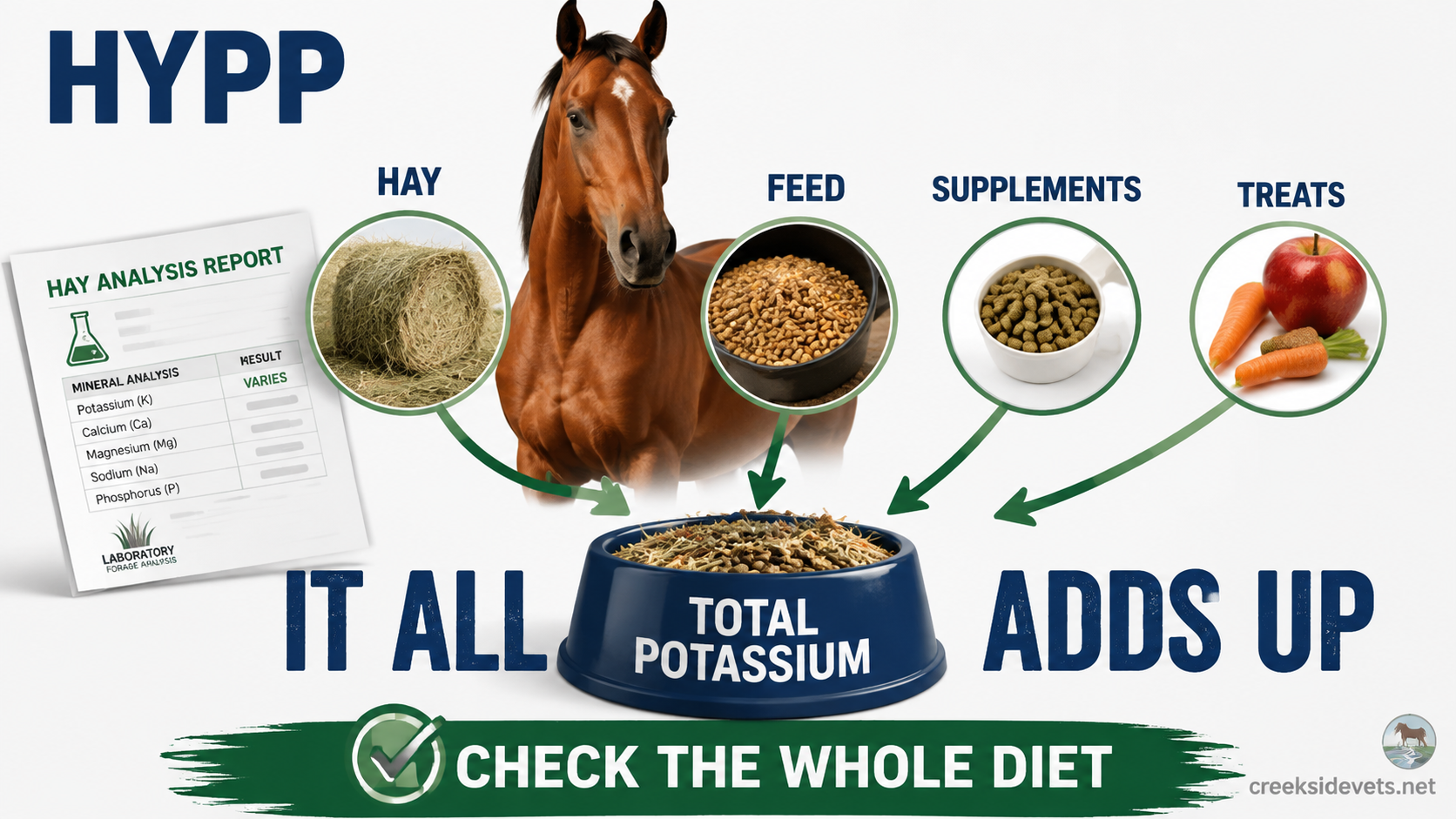
For HYPP horses, potassium from hay, feed, supplements, and treats all contributes to the total daily diet.
4. Why Treat Size Matters
Here’s the easiest way to think about an HYPP treat:
Potassium concentration × amount fed = potassium contribution
A food can contain potassium without being automatically forbidden. The portion changes the equation.
For example, there is a major difference between:
- one small piece of fruit occasionally
- several whole pieces every day
- a handful of fruit during training
- repeatedly rewarding the horse throughout a long session
The food hasn’t changed. The amount has.
That’s why I would be cautious about online lists that simply label foods “safe” or “unsafe” without giving any thought to portion size.
Ask yourself: How much am I actually feeding? A measured small piece is easier to manage than an open-ended handful.
5. Where Is the Horse Getting Most of Its Potassium?
Before blaming the treat, look at the rest of the feed bucket.
Forage
Forage often contributes a large share of daily potassium simply because it makes up most of the ration.
And potassium can vary considerably between hay samples.
Grass hay generally contains less potassium than alfalfa and other legumes, although the actual concentration depends on the forage and growing conditions.
Concentrates
Some feed ingredients deserve particular attention in HYPP diets. These include:
- Alfalfa
- Molasses
- Soybean meal
Veterinary HYPP guidance specifically identifies these as higher-potassium ingredients that may need to be avoided or replaced.
Supplements and electrolytes
This is an easy one to overlook. Some electrolyte products contain potassium. So don’t assume: “It’s an electrolyte, therefore it’s safe for HYPP.” Check the ingredient list.
6. Which Foods Should an HYPP Horse Avoid or Limit?
Rather than creating a giant forbidden-food list, I prefer to separate high-potassium ingredients from foods that can simply be managed through portion control.
| Food or ingredient | Practical approach |
|---|---|
| Alfalfa | Usually avoid or replace in a potassium-restricted HYPP diet unless specifically included in a veterinary-formulated ration |
| Molasses | Avoid high amounts, check sweet feeds and treats |
| Soybean meal/oil | Review the contribution to the complete ration |
| Canola oil | Consider the potassium contribution when formulating the diet |
| Potassium-containing electrolytes | Check the label before feeding |
| Alfalfa-based treats or pellets | Check the actual formulation and potassium content |
| High-potassium produce | Use measured portions rather than feeding freely |
The important distinction is: high potassium does not automatically mean poisonous. The concern is how that ingredient fits into the horse’s total dietary potassium exposure.
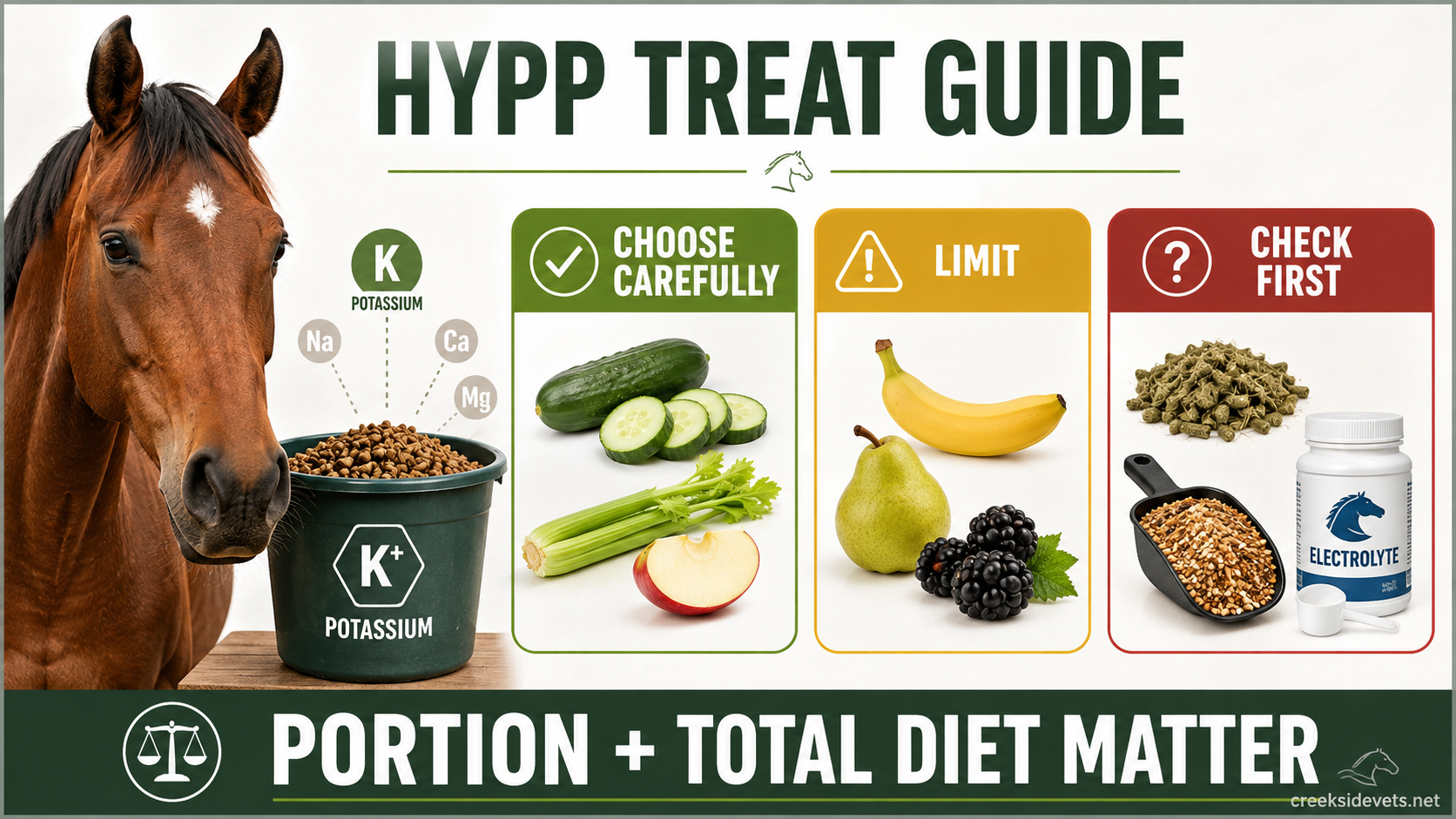
HYPP treat choices: portion size and the horse’s total potassium intake both matter.
7. What About Bananas, Apples and Pears?
This is where the simple “never feed fruit” advice becomes less useful.
Bananas
Bananas are relatively potassium-rich, so they are not a treat I would feed freely or routinely to an HYPP horse.
If the horse’s diet is already close to its potassium target, there may be little reason to add a potassium-dense treat simply because the horse enjoys it.
Apples and pears
Apples and pears should not automatically be placed in the same category as high-potassium feed ingredients such as alfalfa or molasses.
The practical question is:
How much does the portion contribute to the horse’s total potassium intake?
If you are considering pear specifically, see can horses eat pears? for the portion and feeding considerations discussed for horses with metabolic concerns.
Berries
If you’re choosing between berries, blueberries are generally the lower-potassium option, while blackberries tend to be higher. That does not make blackberries automatically unsafe, but it does make portion control more important for an HYPP horse.
See Can Horses Eat Blueberries, Strawberries & Raspberries? for a closer look at these fruits.
8. Lower-Potassium Reward Choices
If your horse receives food rewards regularly, you don’t necessarily need to stop rewarding altogether. Instead, make the reward small, predictable and easy to measure.
| Treat | Practical starting portion | Why it can work |
|---|---|---|
| Cucumber | 2–3 thin slices | High moisture and easy to portion |
| Celery | 1–2 small pieces | Easy to divide into tiny rewards |
| Apple | Small, thin slice | Provides a measured portion rather than unrestricted fruit |
| Low-potassium grass-hay pellets | 3–5 small pellets | Keeps the reward forage-based when the potassium content is verified |
These are starting portions, not universal maximums.
Celery can be useful when you want a small, low-sugar, easy-to-portion reward. See Can Horses Eat Celery? for preparation, serving size, and general feeding considerations.
An HYPP horse whose total ration is already tightly controlled may need a different approach.
If you are using treats for training, cut one piece into several very small rewards. The horse experiences several rewards. You have not necessarily added several times the amount of food.
9. Your Hay May Matter More Than Your Treat
This is one of the most important practical points in the entire article.
If your horse is eating several kilograms of hay every day, the potassium contribution from that forage can dwarf the contribution from an occasional small treat. And hay potassium is not fixed. It can vary with:
- Forage species
- Plant maturity
- Soil conditions
- Fertilizer
- Growing conditions
- Harvest conditions
That is why forage testing is much more useful than guessing from the color or type of hay. Merck specifically recommends laboratory analysis because forage potassium can vary widely.
If potassium restriction is important for your horse: have the current forage tested. Don’t assume that last year’s hay has the same potassium concentration as this year’s hay.
10. Can Soaking Hay Help?
Yes, soaking can reduce potassium because some potassium moves from the hay into the soaking water. However, soaking is not a magic reset button. The amount of potassium removed depends on factors including:
- Type of forage
- Soaking time
- Water temperature
- Starting potassium concentration
University of Minnesota guidance recommends using forage testing before and after soaking when managing horses with HYPP, rather than assuming a particular soaking time produces a predictable potassium reduction.
So if soaking is part of your horse’s management plan: test the hay rather than guessing how much potassium the soaking removed.
Also remember that soaking can remove other water-soluble nutrients and reduce dry matter.
11. Feeding Consistency Matters
With HYPP, the feeding routine matters almost as much as the ingredient list. Sudden dietary changes can trigger episodes. That means you should avoid suddenly:
- Switching hay
- Adding a new concentrate
- Changing supplements
- Increasing treats
- Changing the feeding schedule
- Introducing a large amount of a new feed
If your horse is doing well on a carefully controlled ration, don’t make several changes at once. When a change is necessary, discuss the transition with your veterinarian or equine nutritionist.
If you’re changing a forage, feed, or introducing a new treat, make the change gradually. Our guide explains how to introduce a new food to your horse without making unnecessary dietary changes.
12. What About Salt and Electrolytes?
Your HYPP horse still needs sodium and chloride. Plain salt is commonly provided to horses to help meet sodium and chloride requirements. The important distinction is that salt is not the same thing as a potassium-containing electrolyte supplement.
Some commercial electrolyte products contain potassium. Before feeding one, check the label for ingredients such as:
- Potassium chloride
- Potassium salts
- Other potassium-containing mineral sources
- Don’t assume an electrolyte is automatically appropriate.
If your horse sweats heavily or has an increased electrolyte requirement, ask your veterinarian how that need should be handled within the HYPP diet.
If you’re reviewing several ingredients or feeds at once, see what can horses eat? for practical guidance on common horse foods and feeding considerations.
13. What Should You Do During an HYPP Episode?
HYPP episodes can range from mild muscle twitching to severe weakness and collapse. Signs may include:
- Muscle twitching
- Trembling
- Sweating
- Weakness
- Difficulty standing
- Collapse
- Abnormal breathing in severely affected horses
Safety comes first. A horse experiencing an episode may become unstable and fall.
Keep yourself and others out of the horse’s fall zone and contact your veterinarian for instructions, particularly if:
- the signs are severe
- the horse is collapsing
- breathing is abnormal
- the episode is prolonged
- you are not sure whether the signs are actually HYPP
Some horses with known HYPP may have a veterinary-directed plan for managing early mild episodes, while severe episodes can require emergency treatment.
Don’t improvise with supplements. Do not give potassium-containing electrolytes or attempt to correct an episode with homemade electrolyte mixtures.
If your horse has a history of HYPP episodes, ask your veterinarian before an emergency occurs for a written plan explaining exactly what you should do.
14. Non-Food Rewards Can Make HYPP Management Easier
If you’re training a horse and handing out 30 treats during a session, the easiest way to reduce dietary exposure may be to change some of the rewards—not necessarily eliminate them all. Try:
- Wither scratching
- Neck rubbing
- Grooming
- Verbal praise
- Target training
- Releasing pressure immediately after the desired response
Food can still be useful when it fits the ration. But non-food rewards give you another way to reinforce behavior without adding potassium to the feed bucket.
15. The HYPP Treat Checklist
Before giving your horse a new treat, ask yourself five questions.
1. How much potassium does it contain?
Use reliable nutritional information when available.
2. How much am I actually feeding?
A thin slice and a handful are very different amounts.
3. How often am I feeding it?
One occasional reward is different from repeated rewards every day.
4. What is already in the ration?
Look at hay, pasture, concentrates, supplements, electrolytes.
5. What potassium target has been established for this horse?
If your horse has clinically significant HYPP, your veterinarian or equine nutritionist can help determine the appropriate total-diet target.