
The average adult horse weighs between 900 and 2,200 pounds (400–1,000 kg), but there is no single “normal” weight for every horse. Most riding horses fall somewhere around 1,000 to 1,200 pounds, while smaller ponies may weigh only a few hundred pounds and large draft horses can exceed 2,000 pounds.
Average Horse Weight at a Glance
Horse weight can vary significantly depending on size, breed, and body type. The ranges below provide a general guide for common horse categories, but individual horses may fall outside these numbers while still being healthy.
| Horse Type | Average Weight (lb) | Average Weight (kg) |
|---|---|---|
| Miniature Horse | 150–350 lb | 68–159 kg |
| Pony | 400–900 lb | 181–408 kg |
| Small Riding Horse | 800–1,000 lb | 363–454 kg |
| Average Riding Horse | 1,000–1,200 lb | 454–544 kg |
| Large Sport Horse | 1,200–1,600 lb | 544–726 kg |
| Draft Horse | 1,600–2,200+ lb | 726–998+ kg |
Breed provides a useful estimate of expected weight, although individual body condition and workload remain more important.
For example, a muscular performance horse may weigh more because of developed muscle, while a less active horse may weigh more because of excess fat. Veterinarians evaluate the individual horse rather than comparing it only with a breed average.
What Factors Determine a Horse’s Weight?
A horse’s weight is influenced by more than its breed or size. Two horses with the same height can have very different weights because their body structure, muscle development, and lifestyle may not be the same.
Breed and Genetics
Breed provides a general expectation for weight because horses were developed for different purposes. Their original jobs influenced their bone structure, muscle mass, and overall body type.
Draft horses, such as Clydesdales and Shires, were bred for pulling heavy loads, so they typically have heavier bone and greater body mass. In contrast, Arabians developed as endurance horses and usually have a lighter, refined frame. Quarter Horses often have a compact, muscular build designed for strength and versatility.
Breed provides an expected weight range, but individual body condition remains more important than breed averages.
Height and Body Frame
Taller horses generally weigh more because they have larger skeletons and more overall body mass. However, height alone does not tell the complete story.
A 15-hand Quarter Horse and a 15-hand Thoroughbred may have different weights because their body frames are built differently. Bone thickness, muscle distribution, and body shape all influence the final number on the scale.
Muscle vs Fat
A horse’s weight does not show whether that weight is healthy. Veterinarians look at body composition to understand what makes up that weight.
A performance horse may weigh more because it has:
- developed topline muscles
- stronger hindquarters
- better athletic conditioning
An overweight horse may also weigh more because of:
- excess fat deposits
- reduced activity
- an imbalance between calorie intake and energy use
Age
A horse’s weight naturally changes throughout life.
Foals gain weight rapidly as they grow and develop, with major changes occurring during their first years. Adult horses usually maintain a more stable weight when nutrition and activity are appropriate.
Age-related weight loss is often associated with dental wear, muscle loss, and other changes that become more common throughout a horse’s lifespan.
Horse Weight by Size
Horse size provides a useful estimate of weight, but body condition determines whether that weight is healthy.
How Much Does a Miniature Horse Weigh?
Miniature horses usually weigh between 150 and 350 pounds (68–159 kg). Their small size does not protect them from weight-related health concerns, and even a small increase in body fat can significantly affect their body condition.
Miniature horses can easily become overweight when they receive more calories than they need. Excess weight can increase the risk of metabolic problems, so owners should monitor body condition rather than relying only on appearance.
How Much Does a Pony Weigh?
Ponies typically weigh between 400 and 900 pounds (181–408 kg), although some larger pony breeds may fall outside this range.
Their compact body structure can make them weigh more than expected for their height. Many ponies are efficient at maintaining weight, which means they may gain excess fat even with moderate feed intake.
Average Riding Horse Weight
Most riding horses weigh around 1,000 to 1,200 pounds. (454–544 kg) This range commonly includes breeds such as:
- Quarter Horses
- Thoroughbreds
- Morgans
- Smaller Warmbloods
However, riding discipline and body type can influence weight. A muscular performance horse may weigh more than a lighter-framed horse of similar height because of increased muscle development.
Large Horse Weight
Large sport horses, including many Warmbloods and larger riding breeds, commonly weigh between 1,200 and 1,800 pounds (544–816 kg).
Their increased height, heavier bone structure, and greater muscle mass contribute to the higher weight range. Because of their size, these horses may require careful attention to nutrition, workload, and joint health.
How Much Does a Draft Horse Weigh?
Draft horses, including breeds such as Clydesdales, Shires, and Percherons, typically weigh around 1,600 to 2,200+ pounds (726–998+ kg).
Their large frame and powerful musculature were developed for pulling heavy loads. Due to their size, veterinarians consider body weight when calculating medication doses, planning nutrition requirements, and managing joint stress.
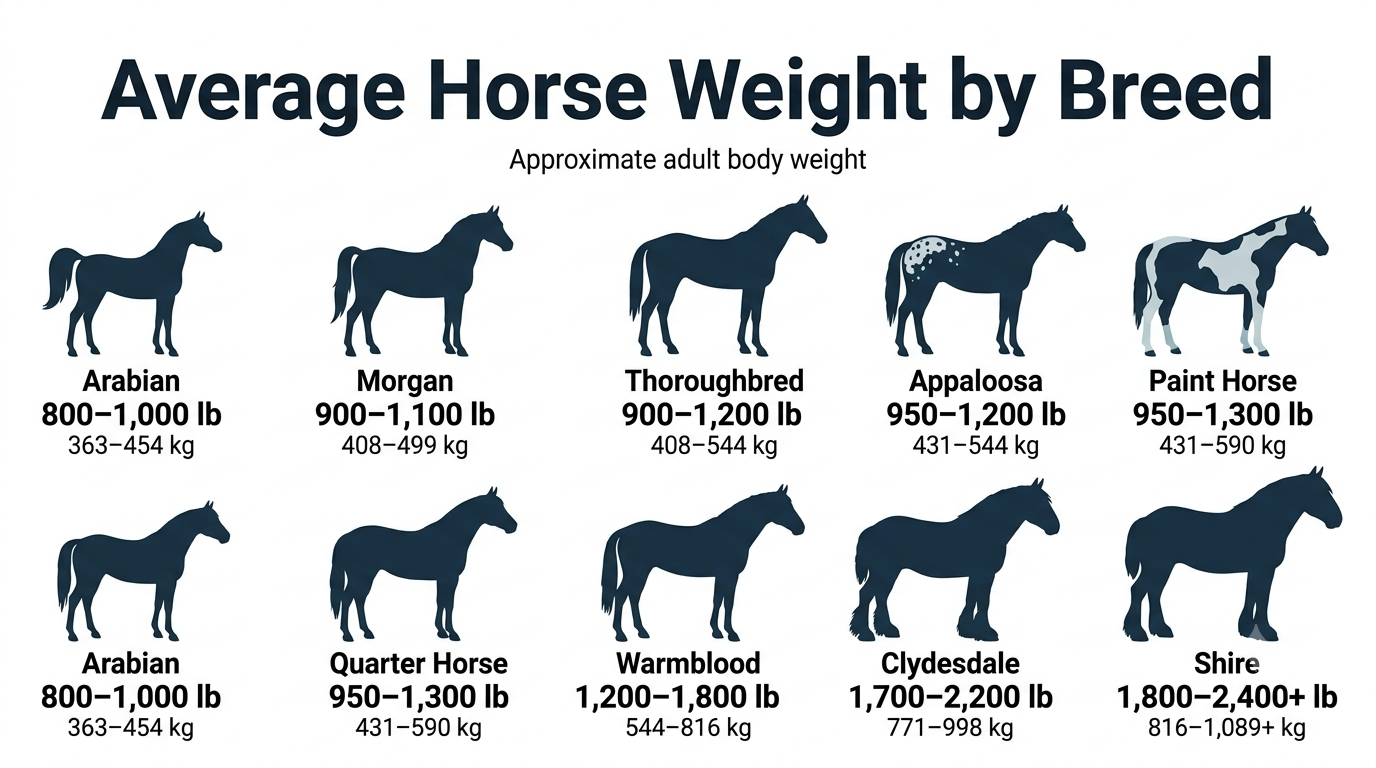
Horse Weight by Breed
Breed provides a useful estimate of expected weight, although individual horses may fall outside the average because of differences in frame, conditioning, and workload.
The table below shows common weight ranges for popular horse breeds.
| Breed | Average Weight (lb) | Average Weight (kg) |
|---|---|---|
| Arabian Horse | 800–1,000 lb | 363–454 kg |
| Thoroughbred | 900–1,200 lb | 408–544 kg |
| Quarter Horse | 950–1,300 lb | 431–590 kg |
| Morgan Horse | 900–1,100 lb | 408–499 kg |
| Appaloosa | 950–1,200 lb | 431–544 kg |
| Paint Horse | 950–1,300 lb | 431–590 kg |
| Warmblood | 1,200–1,800 lb | 544–816 kg |
| Clydesdale | 1,700–2,200 lb | 771–998 kg |
| Shire | 1,800–2,400+ lb | 816–1,089+ kg |
How Much Does a Quarter Horse Weigh?
An adult American Quarter Horse typically weighs between 950 and 1,300 pounds (430–590 kg). Their broad chest, dense bone, and naturally muscular build make them heavier than many other light riding horse breeds of similar height.
Weight varies considerably depending on bloodline and intended use.
- Foundation (or “Bulldog”) Quarter Horses have a stockier frame and often weigh 1,150–1,350 pounds (520–612 kg).
- Semi-Bulldog types generally weigh 1,050–1,250 pounds (475–567 kg).
- Running or Racing Quarter Horses, which carry more Thoroughbred influence, are leaner and commonly weigh 1,050–1,200 pounds (475–544 kg).
- Halter-bred Quarter Horses, selected for exceptional muscle development, frequently exceed 1,200 pounds (545 kg).
Because muscle mass differs greatly between these bloodlines, veterinarians interpret a Quarter Horse’s weight alongside its body condition and intended athletic purpose rather than comparing it with a single breed average.
How Much Does a Thoroughbred Weigh?
An adult Thoroughbred typically weighs 900–1,200 pounds (410–545 kg), with many mature horses averaging around 1,000 pounds (450 kg). Their lean, athletic build and lighter bone structure generally make them lighter than many riding breeds of similar height.
Why Can Thoroughbred Weights Vary?
A healthy Thoroughbred’s weight depends on several factors, including:
- Athletic purpose: Sprint-bred horses often carry more muscle mass than horses conditioned for longer-distance racing.
- Height and frame: Most Thoroughbreds stand 15–17 hands high. Taller, larger-framed horses naturally weigh more than smaller individuals.
- Sex: Stallions are generally heavier than mares because they develop a larger frame and greater muscle mass. Geldings often fall between the two.
- Conditioning: Horses in active race training usually have less body fat than retired or recreational Thoroughbreds, even when both are at a healthy weight.
Veterinarians interpret these differences alongside the horse’s height, body condition, and intended use rather than relying on breed averages alone.
How Much Does an Arabian Horse Weigh?
An Arabian horse generally weighs between 800 and 1,000 pounds (360–450 kg). Their refined frame, lighter bone structure, and endurance-focused build make them one of the lighter riding breeds.
Many purebred Arabians also have one fewer rib pair, one fewer lumbar vertebra, and one fewer tail vertebra than most other horse breeds, contributing to their distinctive short back and compact body.
How Much Does a Warmblood Weigh?
A Warmblood horse typically weighs between 1,100 and 1,500 pounds (500–680 kg). Unlike a single breed, Warmblood refers to a group of sport horse breeds, so weight varies depending on the registry, height, and build.
Dutch Warmbloods, Hanoverians, Holsteiners, and Trakehners each have slightly different average weights, but all are bred for athletic performance with substantial bone and muscle, making them heavier than many light riding breeds.
How Much Does a Baby Horse Weigh?
A newborn foal typically weighs 80–120 pounds (36–54 kg) at birth, although healthy birth weight varies with breed. As a general guideline, a foal weighs about 10% of its dam’s (mare’s) body weight. Healthy weight gain during the first months of life also depends on normal pregnancy, foaling, and nursing.
Birth weights differ by horse type:
- Miniature horses and ponies: 20–50 pounds (9–23 kg)
- Light horse breeds (such as Quarter Horses and Thoroughbreds): 80–120 pounds (36–54 kg)
- Draft horse breeds: 150–200 pounds (68–91 kg)
Veterinarians pay close attention to birth weight because unusually small or large foals may require closer monitoring after delivery. Healthy foals should stand and nurse within the first few hours of life and then gain weight rapidly during their first months as they grow toward their adult size.
How Veterinarians Evaluate a Healthy Horse Weight
A healthy horse weight is not determined by a single number on a scale. A veterinarian does not simply ask, “Does this horse weigh 1,100 pounds?” They evaluate whether the horse is carrying the right amount of body condition for its breed, age, workload, and health status.
Body Condition Score (BCS)
Veterinarians commonly use the Body Condition Score (BCS) system to evaluate how much fat a horse is carrying. This scale ranges from 1 to 9:
1 = Extremely thin
5 = Ideal body condition
9 = Obese
The assessment focuses on areas where fat commonly accumulates, including:
- ribs
- neck crest
- withers
- shoulders
- tailhead
Excess fat over the neck crest, ribs, shoulders, or tailhead may indicate obesity and increase the risk of conditions such as equine metabolic syndrome and laminitis.
Muscle Condition Score
Weight does not show how much of a horse’s body is muscle versus fat. A horse can have an acceptable weight but still have poor muscle development, especially along the back and hindquarters.
Veterinarians evaluate:
- topline muscle
- back strength
- hindquarter development
- neck muscle condition
Muscle loss along the topline can occur even when overall body weight appears normal, particularly in older horses or those recovering from illness.
Two horses can weigh exactly the same yet have very different health profiles. One may have well-developed muscle and an ideal body condition, while the other carries excess body fat that increases the risk of metabolic disease. This is why veterinarians interpret body weight together with body condition and muscle assessment rather than relying on the scale alone.
How Much Should a Horse Weigh?
There is no universal “ideal” weight for every horse. Instead, veterinarians aim for a body condition that supports the horse’s age, workload, and health.
For example:
- A competition horse may need strong muscle development to support performance.
- A senior horse may require a different weight goal because maintaining body condition can become more difficult.
- A lightly worked horse may need fewer calories than a horse in regular training.
How to Estimate a Horse’s Weight
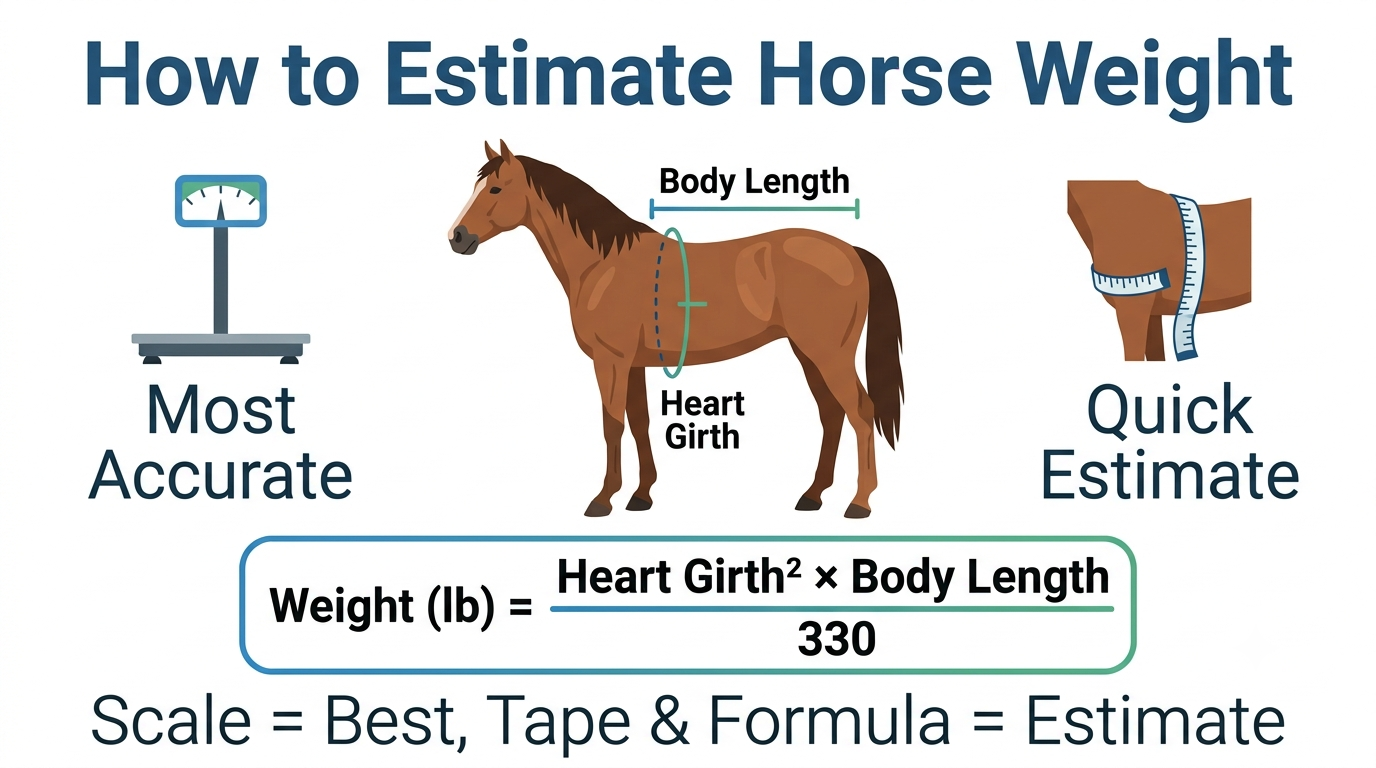
Knowing a horse’s approximate weight is useful for many reasons, including medication calculations, nutrition planning, and monitoring changes over time. It also provides a starting point for assessing how much weight a horse can carry, alongside factors such as conformation, fitness, age, and workload. The most accurate method to estimate weight is using a scale, but owners often rely on other practical methods when a scale is not available.
Livestock Scale
A livestock scale provides the most accurate measurement of a horse’s weight. This method is commonly used by veterinary clinics, research facilities, and farms where precise measurements are needed.
Accurate weight information is especially useful when calculating medication doses, adjusting feed amounts, or tracking gradual weight changes.
Horse Weight Tape
A horse weight tape is a simple tool that estimates weight by measuring the horse’s heart girth around the chest.
Weight tapes are affordable and convenient for regular monitoring, especially when owners want to track whether a horse is gaining or losing weight.
However, they provide an estimate rather than an exact measurement. Results can be affected by body shape, muscle development, pregnancy, or unusual conformation.
While weight tapes are useful for monitoring changes over time, research has shown that traditional estimation methods may differ from a horse’s actual body weight by 5–25%, particularly in horses with unusual body types. More advanced equations improve accuracy but are less practical for everyday use.
Weight Formula Calculations
When a livestock scale is unavailable, body weight can be estimated using heart girth and body length measurements.
Adult horse weight formula:
Weight (lb) = (Heart Girth² × Body Length) ÷ 330
Where:
Heart girth = circumference of the chest, measured just behind the front legs.
Body length = distance from the point of the shoulder to the point of the buttock.
In a University of Minnesota study involving 629 adult horses and ponies, researchers found that owners frequently misjudged their horse’s body weight. The study also developed improved weight estimation equations using additional body measurements, highlighting the limitations of traditional heart-girth formulas when greater accuracy is required.
Why Horse Weight Matters in Veterinary Care
A horse’s weight is important in veterinary care because many health decisions depend on knowing the approximate size and condition of the animal. Weight helps veterinarians make safer decisions about medication, nutrition, and monitoring changes in health.
Medication Dosage
Many veterinary medications are calculated based on body weight. An accurate weight estimate helps determine appropriate doses for treatments such as:
- antibiotics
- anti-inflammatory medications
- sedation drugs
- dewormers
Even a 10% error in estimated body weight can affect the dose of medications or dewormers. Whenever accurate dosing is critical, a livestock scale remains the preferred method.
Nutrition Planning
Weight helps guide feeding decisions by providing an estimate of the horse’s energy requirements. A 600-pound pony and a 1,600-pound draft horse will have very different nutritional needs.
Veterinarians and nutrition professionals consider weight along with body condition, activity level, forage quality, and workload when making feeding recommendations. For owners who like offering treats, understanding safe and unsafe foods for horses is just as important as portion size.
Monitoring Health Changes
Changes in body weight can provide important clues about a horse’s health. Unexpected weight loss or gain may indicate that something has changed with nutrition, dental health, digestion, or overall wellbeing.
Tracking weight trends over time helps veterinarians identify problems earlier and determine whether management changes are working.
When Weight Loss or Weight Gain Is a Concern
Changes in a horse’s weight are often more important than the actual number on the scale. A gradual change may be expected during different life stages, but sudden or unexplained changes can indicate an underlying issue that needs attention.
Unexpected Weight Loss
A horse that loses weight despite having normal access to feed may need further evaluation. Common causes can include:
- dental problems that make chewing difficult
- Heavy parasite burdens (especially in younger horses)
- poor nutrition or insufficient calorie intake
- digestive issues
- Chronic pain reducing intake
Digestive problems can contribute to weight loss by affecting nutrient absorption or reducing feed intake due to discomfort. Unlike many animals, horses cannot throw up, which means gastrointestinal problems may not always present with obvious signs. Instead, owners may notice changes such as unexplained weight loss, reduced appetite, changes in manure, or recurring colic symptoms.
Senior horses are especially prone to weight loss because dental wear and changes in digestion can make it harder to maintain body condition. Weight loss despite a normal appetite, progressive topline muscle loss, or difficulty chewing should prompt a veterinary examination.
Difficulty Maintaining Weight
Some horses require extra support to maintain a healthy weight, especially older horses or those with higher energy demands.
Common situations include:
- senior horses with reduced ability to process feed efficiently
- horses with dental issues affecting food intake
- performance horses needing additional calories for workload
Veterinarians may evaluate diet, dental health, and overall condition when a horse struggles to maintain weight.
Excess Weight Gain
Extra weight is not simply a cosmetic concern. Horses carrying excessive body fat have a higher risk of health problems, including:
- obesity
- insulin resistance
- equine metabolic syndrome
- laminitis
Excess body fat can affect how a horse’s metabolism functions and may increase the risk of metabolic disease, especially in horses that are prone to weight gain. Regular body condition assessments help owners recognize changes early and adjust feeding and management before problems develop.
For horses that need to lose weight, lower-sugar treats such as celery may be a better option, while sugar-containing treats such as watermelon should be portion-controlled.
FAQs About How Much Does a Horse Weigh?
How much does a Clydesdale horse weigh?
A mature Clydesdale typically weighs 1,700–2,200 pounds (770–1,000 kg). Their heavy bone, broad frame, and powerful musculature make them one of the largest draft horse breeds, although exceptionally large individuals may weigh even more.
How much does a Shire horse weigh?
An adult Shire horse typically weighs 1,800–2,400 pounds (820–1,090 kg), making it one of the heaviest horse breeds in the world. Stallions are generally larger than mares, and exceptionally large Shires may exceed this range.
Can you tell a horse’s weight without a scale?
Yes, owners can estimate weight using a horse weight tape or measurement formulas based on heart girth and body length. These methods are useful for tracking trends but are not as accurate as using a livestock scale, especially for horses with unusual body shapes.
What is the healthiest weight for a horse?
The healthiest weight depends on the individual horse. Veterinarians evaluate Body Condition Score, muscle condition, movement, and overall health rather than aiming for one specific number. A horse is at a healthy weight when it maintains appropriate body condition for its breed, age, workload, and lifestyle.