
Key Takeaways
- Foaling occurs in three stages: early labor, delivery of the foal, and passage of the placenta.
- Stage 2 is the most time sensitive stage because delays or abnormal presentation can put the mare and foal at risk.
- Most mares progress through foaling normally, but owners should recognize signs that labor is not progressing as expected.
- A normal delivery requires monitoring, not unnecessary intervention, with veterinary assistance when complications arise.
Foaling is the final stage of a mare’s pregnancy and is usually a rapid process that requires close observation. Most mares deliver healthy foals without assistance, but labor can change quickly if complications develop. Research shows that delays during active delivery are associated with a higher risk of illness and death in newborn foals, making early recognition of abnormal labor especially important. Understanding the normal stages of foaling helps horse owners know what to expect, monitor their mare with confidence, and recognize when prompt veterinary care is needed.
Horse Labor at a Glance
Foaling occurs in three stages, each with a distinct purpose and expected progression. Unlike many other domestic animals, labor in mares is usually rapid, particularly during active delivery. Veterinary studies have shown that prompt recognition of abnormal labor is important because prolonged Stage 2 labor is associated with an increased risk of illness and death in newborn foals. Most healthy mares progress smoothly through all three stages without assistance, but understanding what is normal helps owners recognize when veterinary intervention may be needed.
| Stage | What Happens |
|---|---|
| Stage 1: Early labor | The cervix relaxes, uterine contractions begin, and the foal moves into the correct position for birth. |
| Stage 2: Delivery | Strong contractions push the foal through the birth canal, and the foal is delivered. |
| Stage 3: Passing the placenta | The placenta is expelled as the uterus continues contracting after the foal is born. |
Stage 1: Early Labor
The first stage of labor begins when the mare’s body starts preparing for delivery. During this stage, the cervix gradually relaxes, the uterus begins coordinated contractions, and the foal moves into the correct position within the birth canal. Although these internal changes are not visible, they often cause noticeable changes in the mare’s behavior.
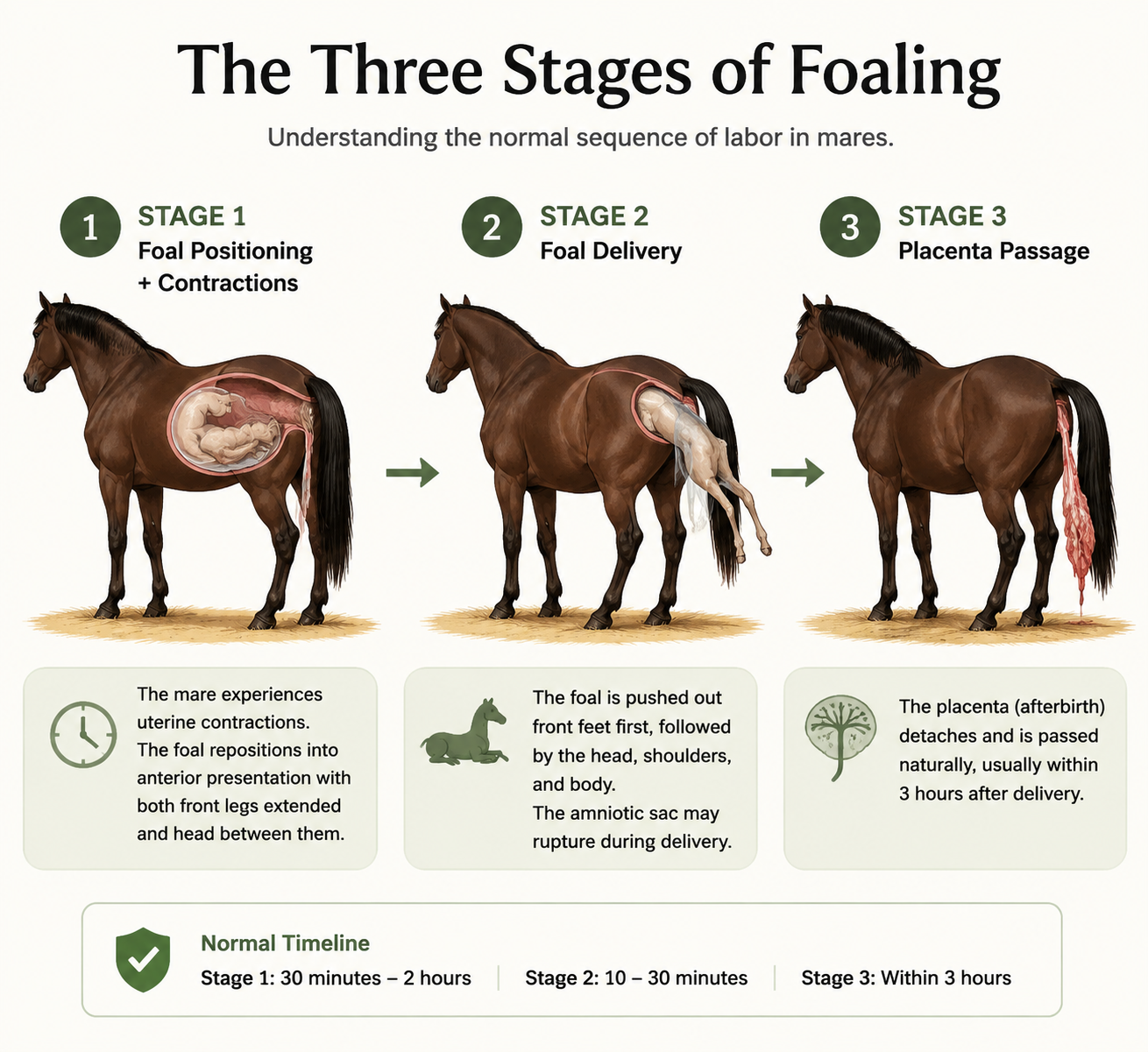
A visual guide showing the three stages of foaling in horses, from foal positioning and contractions to delivery and placenta passage after birth.
Stage 1 usually lasts 1 to 4 hours, although the duration varies between mares. Research and clinical guidelines describe this as the longest stage of labor, but it is generally less physically demanding than active delivery.
During early labor, owners may notice one or more of the following signs:
- Restlessness or pacing
- Repeatedly lying down and standing up
- Pawing at the ground
- Looking toward the abdomen or flanks
- Tail raising or frequent tail swishing
- Sweating, particularly around the shoulders or flanks
- Frequent urination or passing small amounts of manure
- Separating from other horses or seeking a quiet area
These behaviors can resemble mild colic because both conditions cause abdominal discomfort. However, a mare in normal early labor usually continues to progress toward active delivery, while signs of colic often persist or worsen without advancing to foaling.
Monitor the mare from a distance whenever possible and keep the environment calm and quiet. Frequent interruptions or unnecessary handling may disturb a mare preparing to foal. If Stage 1 labor continues for several hours without progressing to active delivery, or if the mare develops severe pain, continuous rolling, or other signs of illness, contact your veterinarian promptly.
Stage 2: Delivery of the Foal
Stage 2 begins when the chorioallantoic membrane (“water bag”) ruptures and active delivery starts. Strong uterine contractions, together with the mare’s abdominal muscles, push the foal through the birth canal. In a normal foaling, this is the shortest stage of labor, usually lasting 10 to 30 minutes.
The normal presentation is both front feet first, with one hoof slightly ahead of the other, followed closely by the nose resting between the knees. This position allows the shoulders and chest to pass through the pelvis as efficiently as possible.
Because the equine placenta begins separating soon after labor starts, Stage 2 progresses much more rapidly than in many other domestic animals. Delays can reduce the foal’s oxygen supply and increase the risk of complications for both the mare and foal.
When Stage 2 May Not Be Progressing Normally
Owners should contact a veterinarian immediately if they notice any of the following:
- Strong contractions without the foal appearing.
- Only one hoof is visible, or no feet appear.
- The nose appears without both front feet.
- The mare stops making progress after active pushing begins.
- A red, velvety membrane appears instead of the normal white amniotic sac (a “red bag” delivery).
- The mare appears exhausted or in severe distress.
Prompt veterinary intervention is critical because dystocia can rapidly threaten the health of both the mare and foal.
Stage 2 is the most time-critical stage of foaling. Once active delivery begins, the placenta gradually starts separating from the uterus, reducing the foal’s oxygen supply. In a normal birth, the foal is delivered quickly before oxygen deprivation becomes significant.
Research has shown that prolonged Stage 2 labor is associated with poorer foal survival and a higher risk of complications for both the mare and foal. For this reason, veterinarians consider delays during active delivery an obstetrical emergency and recommend prompt assessment whenever foaling does not progress normally.
Stage 3: Passing the Placenta
Stage 3 begins after the foal is born and ends when the placenta is expelled. Continued uterine contractions help separate the placenta from the uterine wall so it can be passed naturally. In most mares, this occurs within 3 hours after foaling.
Once the placenta has been expelled, it should be examined carefully to make sure it is complete. Even a small retained piece can increase the risk of serious complications, including uterine infection (metritis), delayed uterine recovery, and laminitis.
Owners should avoid pulling on the placenta, as this can damage the uterus or cause part of the placenta to tear and remain inside the mare. If the placenta has not passed within 3 hours, or appears incomplete, veterinary attention is recommended.
Place the expelled placenta in a clean container or lay it out on a clean surface until your veterinarian has examined it. This makes it easier to identify missing sections that could indicate retained placenta.
Common Foaling Emergencies
Most mares progress through foaling without assistance, but labor can become complicated quickly. Understanding the most common emergencies helps owners recognize when normal foaling has changed and when immediate veterinary support is needed.
Dystocia (Difficult Birth)
Dystocia occurs when the foal cannot be delivered normally because of problems with the foal’s position, size, or the mare’s reproductive tract. Since Stage 2 labor should progress quickly, any delay during active delivery requires prompt veterinary assessment.
Red Bag Delivery (Premature Placental Separation)
A red bag delivery occurs when the placenta separates before the foal is born, causing a dark red membrane to appear instead of the normal white amniotic sac. This is an emergency because the foal’s oxygen supply may be compromised, and immediate intervention is required.
Abnormal Foal Presentation
A normal foal is delivered with both front feet extended and the nose positioned between the knees. Presentations involving a single limb, the head without the feet, hind limbs first, or other abnormal positions can prevent delivery and require veterinary assistance.
Retained Placenta
After foaling, the placenta should be expelled and checked to make sure it is complete. A retained placenta can increase the risk of serious complications, including uterine infection and laminitis, so veterinary attention is recommended if the placenta does not pass normally.
During foaling, the most important information for your veterinarian is timing. Note when Stage 2 begins, when the water breaks, what you see during delivery, and whether the placenta passes normally. These details can help your veterinarian decide how urgently assistance is needed.
When a Mare Goes Past Her Expected Foaling Window
A mare reaching her estimated foaling date does not always mean there is a problem. As explained in our guide to the horse gestation period, normal pregnancies can vary considerably between mares, and the average of 340 days should be treated as a reference point rather than a strict deadline.
A mare reaching her estimated foaling date does not always mean there is a problem. A mare gestation calculator can help estimate when foaling may occur, but the result should be treated as a planning window rather than a strict deadline. As explained in our guide to the horse gestation period, normal pregnancies can vary considerably between mares, and the average of 340 days is only a reference point.
Some healthy mares naturally carry longer pregnancies, so veterinarians consider the mare’s individual history, health status, fetal development, and signs of labor rather than relying on the calendar alone.
Concern increases when a prolonged pregnancy is accompanied by signs that suggest the pregnancy is not progressing normally, such as illness, abnormal discharge, reduced fetal movement, or other changes in the mare’s condition.
| Situation | What it means |
|---|---|
| Mare passes the expected foaling date but remains healthy | Normal variation may still be possible, continue monitoring based on veterinary guidance |
| Pregnancy extends beyond the mare’s usual pattern | Discuss evaluation with your veterinarian |
| Prolonged pregnancy with abnormal signs | Veterinary assessment is recommended to evaluate the mare and foal |
When to Contact Your Veterinarian
A mare is more likely to require veterinary evaluation when a prolonged pregnancy is accompanied by signs that suggest the pregnancy is no longer progressing normally. Contact your veterinarian if you notice any of the following:
- Illness or a sudden change in the mare’s condition
- Fever or loss of appetite
- Abnormal vaginal discharge
- Premature milk leakage
- Signs of premature labor
- Concerns about placental function
- Reduced or abnormal fetal movement
- A pregnancy continuing well beyond the expected foaling window with no signs of normal progression
FAQs About Foaling and Labor in Horses
Can a mare give birth without showing signs of labor?
Yes. While many mares show changes such as restlessness, udder development, or behavioral changes before foaling, some mares show very few obvious signs until labor begins. This is why close monitoring during the expected foaling window is important, especially for mares with previous foaling problems or high risk pregnancies.
Do maiden mares have different foaling patterns?
Maiden mares (mares having their first foal) may show less predictable signs before foaling compared with experienced broodmares. They may develop physical changes at different times or show fewer obvious behavioral signs, so owners should avoid relying on previous expectations from other mares.
Can horses foal during the day?
Yes. Although many mares foal at night or during quiet periods, foaling can occur at any time of day. This is why many owners use monitoring systems or regular observation during the expected foaling window rather than assuming birth will happen overnight.
Should I stay with my mare while she is foaling?
Close observation is recommended once a mare enters active labor, but unnecessary interference should be avoided during a normal delivery. The owner’s role is to monitor progression, keep the environment calm, and be ready to contact a veterinarian if something does not appear normal.
Can a mare eat during labor?
Some mares may continue eating during early labor, while others lose interest in feed as contractions increase. A sudden loss of appetite outside normal labor behavior, signs of illness, or severe discomfort should be discussed with a veterinarian.
What should I prepare before my mare foals?
Before foaling begins, owners should prepare a clean foaling area, have veterinary contact information available, gather basic supplies, and understand the signs of normal and abnormal labor. Preparation is especially important because some foaling emergencies require rapid action.
Can I pull the foal out if delivery is delayed?
Owners should not attempt to pull a foal without veterinary guidance. Difficult births can involve abnormal positioning or complications that require specific correction. Uncontrolled pulling may injure the mare or foal and delay appropriate treatment.
How soon should a newborn foal stand and nurse?
A healthy foal should usually attempt to stand and nurse within the first few hours after birth. Failure to stand, weakness, difficulty nursing, or unusual behavior may indicate that veterinary assessment is needed.