
Horses can eat watermelon, including the flesh, seeds, and rind. It is safe for most healthy horses as an occasional treat, not a daily habit. Horses with insulin problems, laminitis history, or HYPP need a more careful approach, which we cover below.
Can Horses Have Watermelon?
Yes. A ripe watermelon is one of the safer fruit treats you can hand a horse. The flesh, the seeds, and even the rind are all fine for most horses to chew and digest.
That said, “safe” does not mean “unlimited.” Watermelon is still a treat, not a feed. It should sit alongside hay and a properly balanced diet, never replace part of it.
Horses with certain health conditions need a different approach. We will walk through exactly who that applies to further down.
Is Watermelon Good for Horses?
In moderation, yes. Watermelon brings a few real benefits to the table.
It is mostly water. Watermelon runs close to 90 to 92 percent water by weight. On a hot afternoon or after a hard workout, that makes it a genuinely useful way to get extra fluid into a horse that is reluctant to drink.
It carries a light nutrient load. Watermelon flesh contains small amounts of:
- Vitamin A, which supports eyes, skin, and connective tissue
- Vitamin C, which supports immune function
- Vitamin B6, which plays a role in digestion and nerve health
- Lycopene, an antioxidant compound linked to lower inflammation
The rind is not just filler. Most owners toss the rind and hand the horse only the pink flesh. That is backwards. The rind carries more fiber than the flesh and also contains citrulline, an amino acid that supports blood flow. Horses that are allowed to chew the rind are, in a small way, getting the more nutritionally interesting half of the fruit.
Yes, watermelon rind contains L-citrulline, which helps with blood flow, and one study found performance benefits from giving racehorses L-citrulline. But here’s where you need to be careful. The horses were given 50 grams of purified L-citrulline. You’d need a lot more watermelon to get that amount. So don’t start feeding extra rind thinking it’s going to make your horse perform better. The study was on L-citrulline, not watermelon.
It is low in fat, sodium, and calories. A 100 gram serving runs around 30 calories, with essentially no fat and no cholesterol. For an easy keeper, that is a much gentler treat than most commercial horse cookies.
The benefits of watermelon’s vitamins and antioxidants are a bonus. To get a meaningful dose of lycopene or vitamin C into an animal that weighs half a ton, you would need to feed far more watermelon than is safe from a sugar standpoint. Treat the nutrition here as a bonus, not the main reason to feed it.
Is Watermelon Bad for Horses?
For most healthy horses, no. But there are four specific risks worth understanding, not just avoiding blindly.
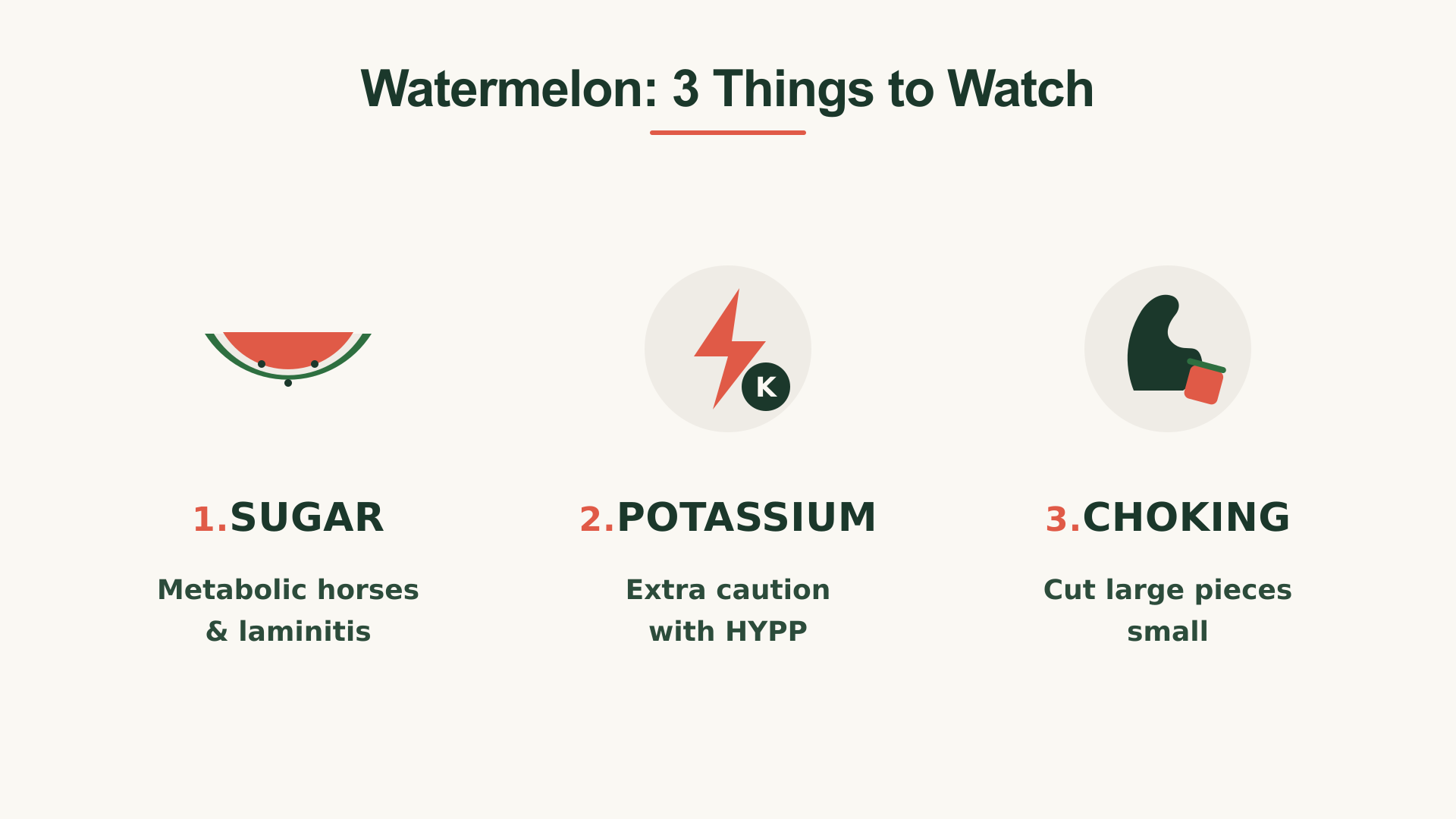
1. Sugar and laminitis risk
Watermelon is sweet because it carries natural sugar, roughly comparable to what you would find in a carrot and well below what fresh spring grass can reach. On its own, an occasional slice is not going to push a healthy horse toward trouble.
The concern is for horses with insulin dysregulation, equine metabolic syndrome, or a history of laminitis. In these horses, sugar and starch intake, referred to by nutritionists as nonstructural carbohydrates, can trigger a spike in insulin. Equine nutritionists at Kentucky Equine Research point to nonstructural carbohydrate intake as a central lever in laminitis risk, and recommend keeping these horses on diets that stay well below the sugar and starch levels found in typical pasture or treats. If you’re looking for a lower-sugar treat for these horses, celery may be a better choice.
2. Choking hazard
Large chunks, and especially firm pieces of rind, can pose a choking risk if a horse tries to swallow without chewing properly. This risk climbs for older horses with worn or missing teeth, and for any horse that tends to bolt its food. Small, manageable pieces solve this almost entirely.
3. Potassium and HYPP
Horses with HYPP need extra care. HYPP disrupts how sodium and potassium move across muscle cell membranes, and it can cause episodes ranging from mild muscle trembling to severe paralysis. Management centers on keeping dietary potassium low.
According to UC Davis Veterinary Medicine, horses managing HYPP generally do best on a diet holding total potassium between about 0.6 and 1.5 percent, with individual meals kept well under 33 grams of potassium.
Watermelon is not a major potassium source compared to feeds like alfalfa, but if you own or manage a Quarter Horse type breed and you are not certain of its HYPP status, that is worth confirming with your vet before making fruit a regular habit.
4. Digestive upset and diet displacement
Any new food can unsettle a horse’s gut, particularly in large amounts or when introduced too fast. Watermelon is also filling and appealing enough that a horse may pick at hay less if treats make up too much of daily intake. Keeping portions small protects both the gut and the overall diet balance.
How Much Watermelon Can I Feed My Horse?
Treat feeding for horses generally follows a simple rule: treats, combined, should make up no more than about 1 percent of a horse’s daily feed ration by weight. For a 1,000 pound horse eating around 20 to 25 pounds of feed and forage a day, that works out to roughly a quarter pound of treats across the entire day, watermelon included.
Here is that broken down by horse size.
| Horse weight | Suggested serving | Frequency |
|---|---|---|
| Under 600 lbs (pony, mini, foal) | 2 to 3 ounces | 2 to 3 times per week |
| 600 to 1,000 lbs (average horse) | 4 to 6 ounces | 2 to 4 times per week |
| Over 1,000 lbs (draft, large breed) | 6 to 10 ounces | 2 to 4 times per week |
Practical Feeding Advice: one or two small triangle slices for an average sized horse is plenty for a single sitting. Owners often report horses handling more without any obvious problem, but sugar sensitivity varies from horse to horse, so starting small and watching the response is the safer path.
If your horse already gets other treats through the week, count watermelon against that same 1 percent budget rather than adding it on top.
How to Safely Feed Watermelon to Horses
- Wash the rind first. Horses will happily eat rind that has not been washed, but any soil, wax, or residue on the surface should be rinsed off before it goes anywhere near feed.
- Cut it small. Chunks around one to two inches keep chewing easy and choking risk low, for both flesh and rind.
- Serve it in a bucket or feed pan, not by hand. Watermelon is slick and juicy. Hand feeding raises the odds of an accidental nip, and horses can get overexcited around a sweet treat.
- Try a slow feeder or treat ball for enrichment. A foraging toy stuffed with small watermelon pieces turns a two minute snack into a longer, more mentally engaging activity.
- Clear out anything uneaten within a couple of hours. Watermelon spoils fast in warm weather and will draw flies and pests if left sitting.
- Introduce it slowly the first time. Offer a small amount, then wait a day and watch manure, appetite, and general behavior before making it a regular addition. This gives the horse’s system time to adapt, as sudden treat changes can upset the beneficial bacteria in a horse’s gut.
My Horse Ate Too Much Watermelon. What Now?
If a horse gets into an unsupervised pile of watermelon, do not panic, but do call your vet for guidance, especially for horses with any metabolic history.
Watch for these signs over the following hours:
- Refusing feed or picking at hay
- Reduced or absent gut sounds
- Loose manure or straining to pass manure
- Kicking or biting at the flank
- Repeated rolling or reluctance to stand
- Sweating without exercise or heat as a cause
- Sore or warm feet, particularly with a strong pulse felt at the pastern
Any of these warrant a call to your vet rather than a wait and see approach, since early laminitis and colic both respond better to prompt attention.
What Other Fruits Can Horses Eat?
Watermelon is far from the only fruit safe for horses in moderation. Others that are generally well tolerated include:
- Apples (core and seeds removed)
- Oranges
- Bananas, peeled
- Berries of most kinds
- Other melon varieties, like cantaloupe or honeydew
- Berries but only a handful of them
- Pumpkin, raw or cooked
- Grapes
- Cherries, only with pits fully removed
Fruits to avoid entirely include avocado, which is toxic to horses, and anything from the nightshade family such as tomatoes or eggplant. Whole stone fruits with pits still in should also be avoided due to choking risk. Chocolate should also be avoided because it contains theobromine and caffeine, which can be harmful to horses.
FAQS about Can Horses Eat Watermelon?
Can foals eat watermelon?
Not until a foal is reliably eating solid feed on its own, generally once it is weaned or well into eating hay and grain alongside nursing. At that point, one or two small pieces with your vet’s approval is reasonable.
Can horses eat watermelon rind?
Yes, and it is arguably the more nutritious half of the fruit thanks to its fiber and citrulline content. Cut it small, especially for older horses or horses with dental issues.
Can horses eat watermelon seeds?
Yes. Seeds typically pass through undigested and do not pose a toxicity risk. Seedless varieties are still a fine, slightly simpler choice.
Can watermelon help a horse with metabolic problems?
No. Watermelon is not a treatment for insulin dysregulation, equine metabolic syndrome, or laminitis. While it contains vitamins and antioxidants, that does not make it a therapeutic food for metabolic horses. These horses need careful control of sugar and starch intake, so watermelon should be treated as an occasional treat, if offered at all