
Key Takeaways
- There is no universal daily sugar limit for every horse. For healthy horses, small amounts of sugary treats can generally be offered occasionally.
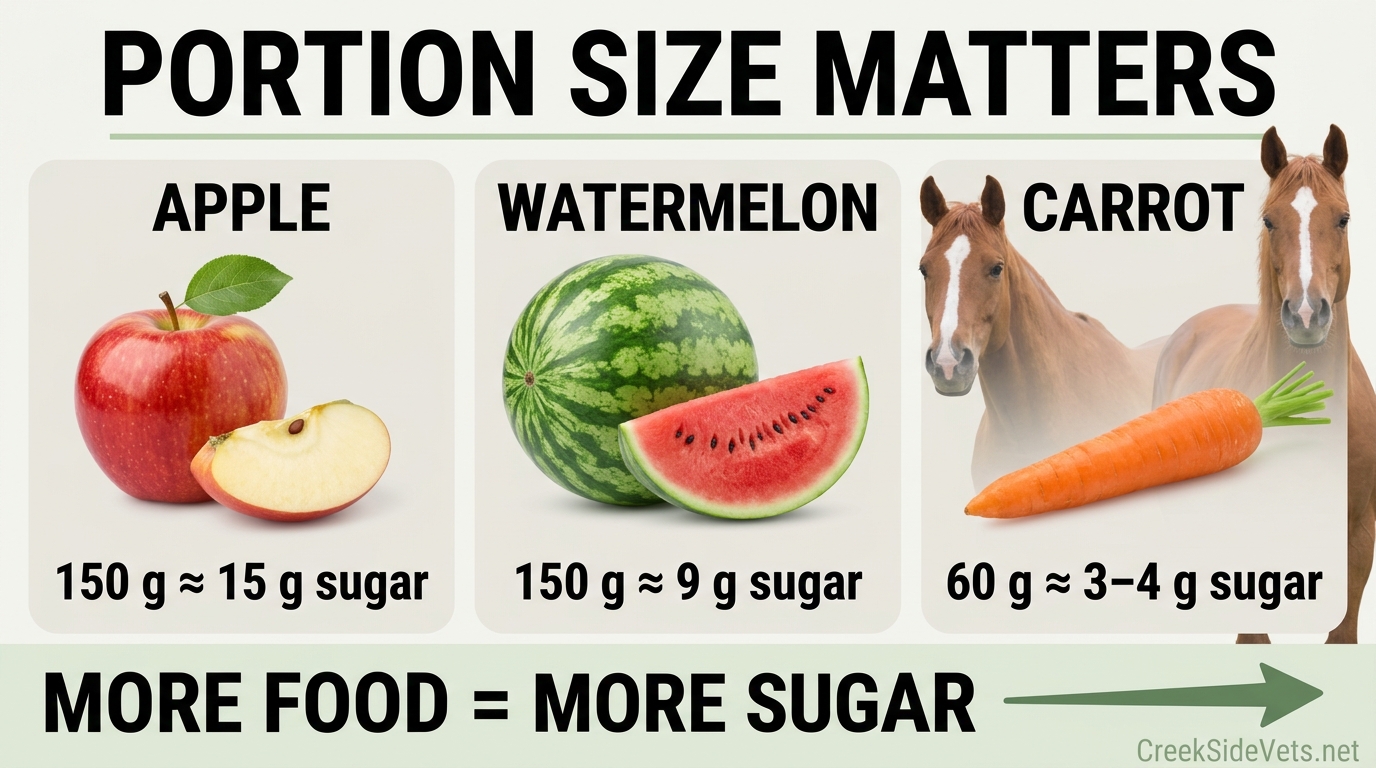
- Portion size matters. The sugar a horse consumes depends on both the food and how much is fed. For example, 150 g of apple provides roughly 15 g of sugar, compared with about 9 g in 150 g of watermelon.
- Treats are only one part of the diet. Hay, pasture, and other feeds can contribute substantially more sugar and NSC than an occasional treat.
- Metabolically sensitive horses need stricter control. Horses with EMS, insulin dysregulation, or a history of endocrinopathic laminitis may require tighter dietary NSC control, so treats need to be considered within the complete ration.
Sugar, Starch, Fructans & NSC: What’s the Difference?
Sugar, starch, and fructans are all carbohydrates, but they are not interchangeable terms. Understanding the difference helps when comparing horse treats, feeds, hay, and pasture.
- Simple sugars: Glucose, fructose, and sucrose.
- Starch: A storage carbohydrate found in foods such as grains and seeds.
- Fructans: Chains of fructose produced by many plants, including grasses.
- WSC (water-soluble carbohydrates): Generally includes simple sugars and fructans.
- NSC (non-structural carbohydrates): A measure that generally includes simple sugars and starch.
The important point is that sugar is only one part of a food’s carbohydrate content. A food can contain relatively little simple sugar but still contribute starch, so sugar alone does not always describe its total NSC.
For horse treats, this means both sugar and NSC can be relevant. For a small fresh treat such as an apple or watermelon, the amount fed and the sugar in that portion are practical ways to estimate its contribution.
When comparing feeds, hay, pasture, or diets where carbohydrate intake needs closer evaluation, NSC provides a broader measure because it includes both simple sugars and starch.
How Much Sugar Is in Common Horse Treats?
The sugar content of a treat depends on the food, variety, ripeness, and serving size. Looking at the amount fed is more useful than labeling a food simply “high sugar” or “low sugar.” Approximate values for common fresh treats:
| Treat | Example serving | Approx. sugar | Practical point |
|---|---|---|---|
| Carrot | 1 medium (~60 g) | ~3–4 g | Small, convenient treat |
| Apple | 1 medium (~150 g edible portion) | ~15 g | More sugar than a small carrot |
| Watermelon | 1 cup (~150 g) | ~9 g | High water content |
| Banana | 100 g | ~12 g | More concentrated than watermelon |
| Berries | 50 g | Varies by type | Small servings naturally limit intake |
These figures are approximate values based on USDA food-composition data, not fixed values for every piece of fruit. Nutrient content can vary with variety, maturity, growing conditions, and serving size.
Why Portion Size Matters
The amount of sugar a horse receives depends on both the food and the portion. The same treat can provide a very different carbohydrate load depending on how much is fed.
For example, 150 g of apple provides roughly 15 g of sugar, compared with about 9 g in the same amount of watermelon. That means the apple provides about 1.7 times as much sugar by weight, even though both are commonly offered as horse treats.
This illustrates why both the type of food and the portion size matter when considering a horse’s sugar intake.
Don’t Forget Hay & Pasture
Treats are only a small part of most horses’ diets. Hay and pasture can contribute far more sugar and other non-structural carbohydrates (NSC) over the course of a day.
Pasture carbohydrate content can change with:
- Season and plant maturity
- Weather and temperature
- Time of day
- Type of grass
- Recent sunlight and growing conditions
These changes can be substantial. In one year, pasture NSC reached 17.1% of dry matter in April, compared with just 5.8% in October. Cool-season grasses can accumulate substantial water-soluble carbohydrates under certain conditions, so a horse grazing lush pasture may consume considerably more carbohydrate from grass than it would from an occasional fruit treat.
This is why looking at one apple, carrot, or other treat in isolation can give a misleading picture of total carbohydrate intake. For horses that need strict carbohydrate control, forage should be evaluated first, with treats considered as part of the remaining dietary carbohydrate allowance.
Why Sugar & NSC Matter for Metabolic Horses
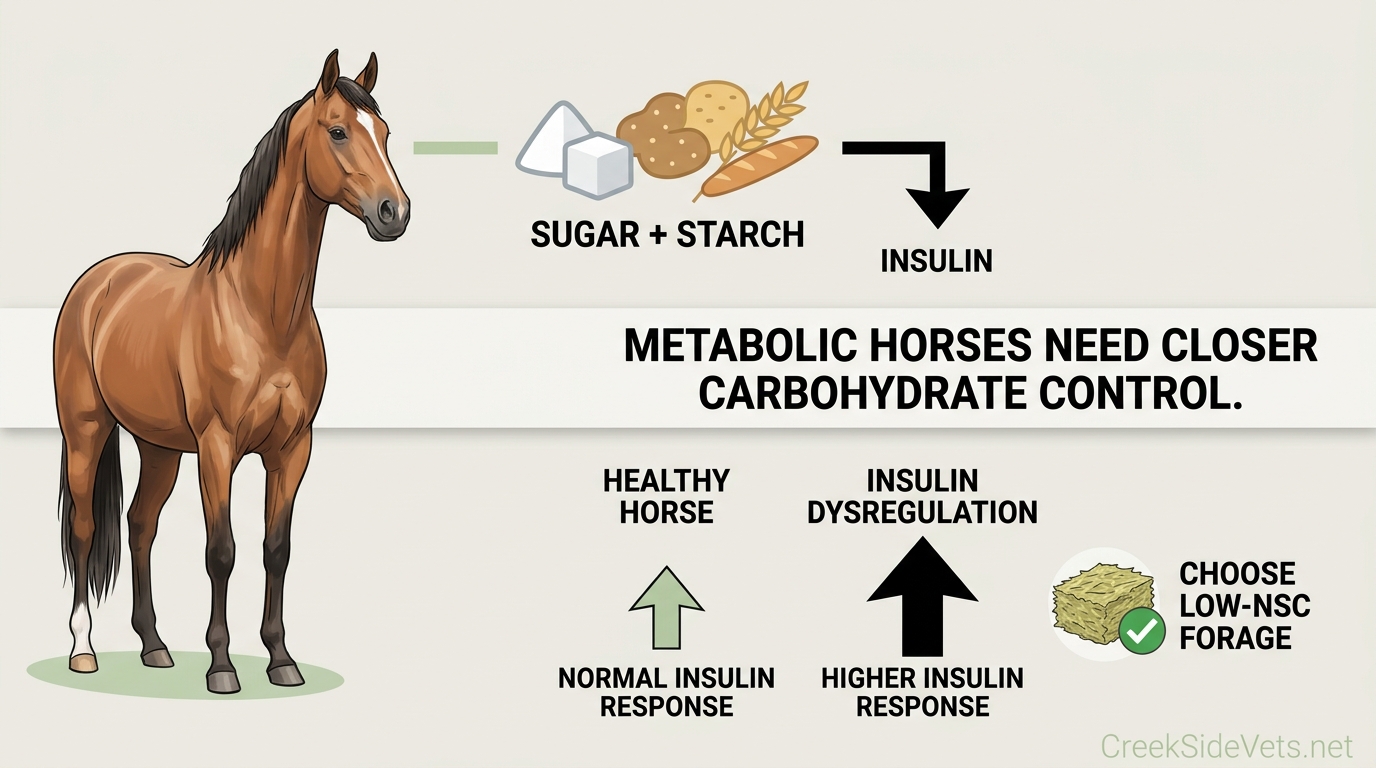
Horses with equine metabolic syndrome (EMS), insulin dysregulation, or a history of laminitis need careful control of sugar and starch.
Digestion of sugar and starch can cause a rise in insulin. In these horses, the insulin response can be much higher than normal. High insulin is strongly linked to laminitis.
Research shows insulin-dysregulated horses have a much bigger insulin response after eating certain feeds. Low-NSC feeds cause a smaller response than high-NSC feeds.
A commonly used veterinary target is to keep forage and the overall diet below about 10% NSC on a dry-matter basis, although the appropriate target depends on the individual horse and its degree of insulin dysregulation.
This is why treats must be considered carefully. Lower-sugar options such as celery or cucumber may be more suitable for a horse that needs strict carbohydrate control, while sweeter fruits should be limited according to the horse’s overall diet.
Practical Ways to Manage Sugar From Treats
For most healthy horses, you don’t need to calculate the sugar content of every treat. A few simple habits can keep treats from becoming a significant source of sugar or calories.
- Keep portions small. A treat should remain a treat, not a meaningful part of the daily ration.
- Limit frequency. Several small servings throughout the day can add up.
- Consider the whole diet. Include hay, pasture, concentrates, and commercial feeds when thinking about total carbohydrate intake.
- Check commercial treat labels. Don’t rely only on terms such as “natural” or “healthy.”
- Avoid stacking sugary treats. Feeding fruit, sweet treats, and other carbohydrate-rich foods together can increase total intake.
- Introduce new foods gradually. Sudden dietary changes can cause digestive upset.
- Adjust for the individual horse. Body condition, workload, metabolic health, and other dietary needs all matter.
For a healthy horse, the goal is moderation rather than complete sugar avoidance. For horses requiring carbohydrate restriction, treat decisions should be made within the context of the complete ration.
Sugar Isn’t the Only Treat Safety Issue
Sugar content matters, but it is only one part of deciding whether a treat is appropriate for a horse.
- Choke risk: Large, firm, or poorly prepared pieces can be difficult to chew and swallow. Proper preparation and portion size can help reduce choke risk.
- Toxicity: Some foods are unsafe regardless of their sugar content, so it’s important to know which foods horses should never eat.
- Pits and seeds: Hard pits can create choking or gastrointestinal obstruction risks.
- Dental health: Horses with poor chewing ability may need softer foods or different preparation.
- Digestive tolerance: New foods should be introduced gradually.
- Calories: Frequent treats can contribute to excess weight even when the food itself is otherwise safe.
So don’t ask only, “How much sugar does this treat contain?” Also ask: Is it safe for horses, appropriately prepared, suitable for this individual horse, and being fed in a reasonable amount?
For preparation guidance, see our guide to horse treat choke hazards. You can also see our What Can Horses Eat? guide for a broader overview of safe foods
FAQs
How much sugar is too much for a horse?
There is no single sugar limit that applies to every horse. The appropriate amount depends on the horse’s overall diet, body condition, metabolic health, and how much of the food is being fed.
Can horses eat sugary fruits?
Yes. Most healthy horses can have fruits such as apples, oranges, and watermelon as occasional treats when offered in appropriate portions. The sugar content and portion size still matter.
Is sugar the same as NSC?
No. NSC generally refers to sugars plus starch, while fructans are a separate carbohydrate category. Sugar is therefore only one part of the broader carbohydrate picture.
Are natural sugars better for horses?
Not necessarily. Sugar from fruit is still sugar, even though whole fruits also provide water and fiber. What matters is how much is fed and the horse’s overall diet, not simply whether the sugar occurs naturally.