
No. Healthy horses cannot vomit because their digestive system is designed for one-way movement. A powerful lower esophageal sphincter (cardiac sphincter) acts as a valve between the esophagus and stomach, preventing stomach contents from moving backward under normal circumstances.
If your horse appears to be throwing up feed, fluid, or foam from the mouth or nostrils, it is usually due to regurgitation from an esophageal obstruction (choke), not true vomiting. Rare cases of true vomiting-like episodes may occur with severe gastrointestinal disease and can indicate dangerous conditions such as gastric reflux, intestinal obstruction, or severe gastric distension that may progress to gastric rupture without urgent treatment.
Can horses throw up? It is one of the most common questions horse owners ask, especially after seeing feed, saliva, or fluid coming from their horse’s mouth or nostrils. While dogs, and many other animals throw up to clear their stomachs, a horse’s digestive system is strictly a one-way path. Therefore, understanding Foods Horses Should Never Eat is an essential part of preventing unexpected gastrointestinal emergencies.
Why Can’t Horses Throw Up?
The answer lies in the unique design of the equine digestive system. Unlike cats, dogs, and many other mammals, a horse’s esophagus and stomach are structured for one-way movement, carrying food from the mouth toward the stomach while strongly resisting backward flow. As described in Equine Surgery by Auer and Stick, several anatomical features of the gastroesophageal junction (including the powerful cardiac sphincter and the angled entry of the esophagus into the stomach) make vomiting extremely difficult in horses.
| Factors | Vomiting Animals | Horses |
|---|---|---|
| Esophageal Sphincter | Relaxes easily to let contents move upward. | Powerful, thick muscle ring acts as a tight, permanent one-way valve. |
| Stomach Entry Angle | Direct, blunt angle allows easy backward flow. | Steep, sharp angle causes rising stomach pressure to lock the junction shut. |
| Neural Reflex | Brain triggers reverse muscle contractions (reverse peristalsis). | Lacks the neural signaling and muscle mechanics to push material upward. |
| Throat & Airway Route | Upper throat opens to expel material cleanly through the mouth. | Elongated soft palate seals the oral cavity, forcing any overflow out the nostrils. |
| Stomach Design | Large capacity tolerates high pressure during active vomiting. | Small, thin-walled organ ruptures under extreme pressure before the valve gives way. |
| Diaphragm | Powerful diaphragm and abdominal contractions help expel stomach contents. | Stomach position and diaphragm mechanics do not generate the force needed for vomiting. |
1. A Powerful Lower Esophageal Sphincter
The primary barrier is a thick ring of muscle called the lower esophageal sphincter (or cardiac sphincter), located where the esophagus meets the stomach.
In animals capable of vomiting, this muscle relaxes on cue to let stomach contents travel upward. In horses, however, it acts as a heavy-duty one-way valve that remains firmly locked, preventing backward movement even when pressure inside the stomach reaches dangerous levels.
2. A Sharp Angle of Entry
The structural entry point provides a second physical seal. Rather than connecting in a straight line, the esophagus meets the stomach at a steep, sharp angle.
As the stomach fills, it expands against this junction, creating a natural mechanism that clamps the entry even tighter. Combined with the strong cardiac sphincter, this structural lock ensures stomach contents stay trapped where they belong.
3. A Disabled Vomiting Reflex
Vomiting isn’t just stomach pressure – it requires a complex neural reflex involving the brain, diaphragm, abdominal muscles, and esophageal sphincters working in tandem.
Horses lack the coordinated neurological sequence required for reverse peristalsis. Even if severe abdominal contractions occur, the lower esophageal sphincter fails to receive the signal to relax, meaning stomach contents cannot be expelled through the mouth.
4. A Small Stomach Built for Constant Grazing
Because horses evolved to graze continuously on small amounts of forage, their stomach is relatively small and relies on continuous movement into the intestines rather than long-term storage.
The downside of this design is an inability to relieve sudden pressure. If gas or fluid accumulates due to colic or gastric reflux, a horse cannot naturally empty its stomach, placing them at severe risk of gastric rupture.
5. The Diaphragm Provides Another Physical Barrier
In many animals, powerful contractions of the diaphragm and abdominal muscles help generate the pressure needed for vomiting. In horses, the stomach sits deep within the rib cage and fits tightly against the diaphragm. Combined with the horse’s unique digestive anatomy, this positioning further limits the ability to force stomach contents back into the esophagus.
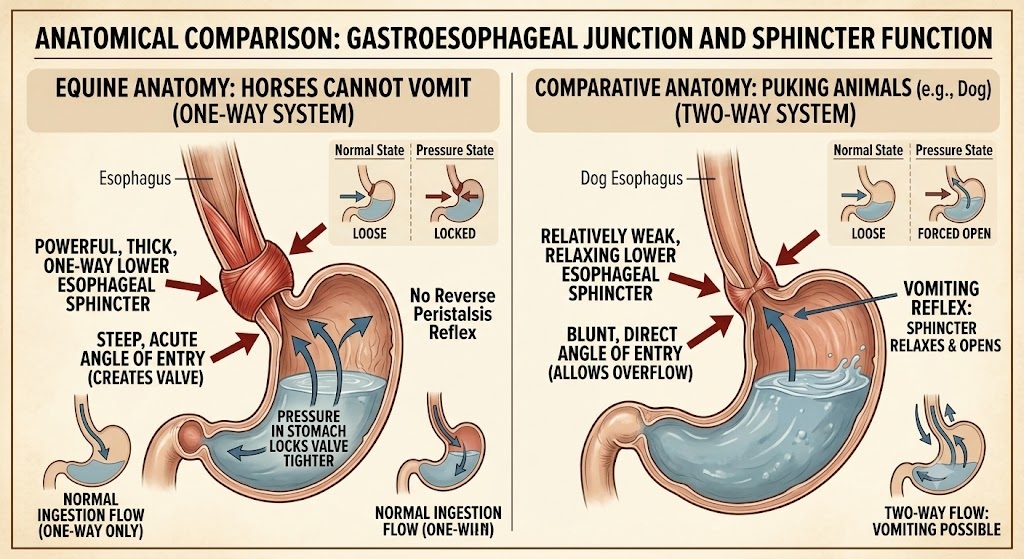
An anatomical illustration breaking down why horses can’t throw up versus animals that can!
Can Horses Regurgitate?
Although many people use the terms vomiting, and regurgitation interchangeably, they describe different processes. While horses cannot vomit stomach contents, they can regurgitate material trapped in the esophagus or upper throat. Understanding the difference between the two helps pinpoint where the underlying issue is located:
| Feature | Vomiting | Regurgitation |
|---|---|---|
| Origin | Comes directly from the stomach. | Comes from the esophagus or upper throat. |
| Process | Active, forceful expulsion driven by abdominal muscles and neural reflexes. | Passive backward flow of swallowed food, water, or saliva before it reaches the stomach. |
| Occurrence in Horses | Physically impossible under normal circumstances due to anatomical barriers. | Occurs when there is an esophageal obstruction or motility disorder (e.g., choke). |
Choke: The Most Common Condition Mistaken for Vomiting
Choke is by far the most common reason owners think their horse is vomiting. Unlike true vomiting, choke is an obstruction of the esophagus rather than the stomach. Feed, saliva, and water become trapped behind the blockage and may drain back through the mouth or nostrils before they ever reach the stomach. To many owners, this can look as though the horse is throwing up, but what they are seeing is actually regurgitated material from the esophagus. Because choke can quickly lead to dehydration, aspiration pneumonia, and injury to the esophagus, owners should always practice preventative feeding methods, such as learning how to prepare horse treats to reduce choke risk.
| Aspect | Equine Choke | True Stomach Vomiting (Rare Crisis) |
|---|---|---|
| Source of Material | Esophagus (feed never reached the stomach). | Stomach or upper small intestine. |
| Appearance | Saliva, water, mucus, and partially chewed feed. | Large volumes of foul-smelling gastric fluid, sometimes mixed with feed. |
| Where Material Exits | Usually from the nostrils, sometimes the mouth. | From the mouth and/or nostrils. |
| Typical Signs | Repeated swallowing, coughing, neck stretching, drooling, and distress. | Severe colic, abdominal distension, shock, collapse, or violent retching. |
| Frequency | Relatively common. | Extremely rare. |
| Urgency | Prompt veterinary treatment is needed. | Immediate life-threatening emergency requiring urgent veterinary care. |
Why True Vomiting Is a Veterinary Emergency
True vomiting is considered an exceptional event in horses. In the landmark paper Inquiry into the Reasons why the Horse Rarely Vomits, researchers analyzed documented cases to determine the diseases responsible when horses did vomit. Rather than occurring as a normal protective reflex, vomiting was associated with advanced gastrointestinal disease that created extreme pressure within the stomach. The principal conditions identified are summarized below.
| Condition | What Happens | Why It Can Lead to True Vomiting |
|---|---|---|
| Primary Gastric Dilation | Feed, fluid, or gas rapidly stretches the stomach after overeating or consuming feeds that expand after ingestion. | Rising stomach pressure may eventually overwhelm the normal one-way barriers. |
| Secondary Gastric Dilation | An intestinal obstruction prevents stomach contents from moving into the intestines. | Fluid backs up into the stomach, causing severe gastric distension and reflux. |
| Severe Colic & Intestinal Obstruction | Twisted intestines, strangulating lesions, impactions, or intussusception stop normal intestinal movement. | Continuous fluid accumulation creates dangerous pressure inside the stomach. |
| Post-Operative Ileus | The intestines temporarily stop moving after abdominal surgery. | Digestive fluids accumulate, causing gastric reflux and progressive stomach distension. |
Primary and Secondary Gastric Dilation
Gastric dilation occurs when the stomach becomes excessively distended with feed, fluid, or gas. Primary gastric dilation is usually caused by rapid overeating or feeds that expand after ingestion, whereas secondary gastric dilation develops when an obstruction farther down the intestinal tract prevents stomach contents from moving normally.
Because horses cannot vomit to relieve the pressure, the stomach continues to stretch. Without rapid veterinary treatment to decompress the stomach and address the underlying cause, gastric rupture can occur.
Severe Colic and Intestinal Obstruction
Some of the most life-threatening forms of colic including strangulating obstructions, intestinal volvulus (twisted intestine), impactions, and intussusception can also lead to severe gastric distension.
Although the blockage may occur well beyond the stomach, digestive fluids continue to be produced. As these fluids back up through the gastrointestinal tract, pressure inside the stomach rises rapidly. This is why veterinarians often pass a nasogastric tube in horses with severe colic to remove accumulated gastric fluid before the stomach reaches a critical point.
Post-Operative Ileus
Post-operative ileus is a complication that can develop after abdominal surgery when the intestines temporarily stop moving normally. Instead of progressing through the digestive tract, fluid accumulates within the stomach and small intestine, resulting in gastric reflux and increasing stomach pressure.
Careful monitoring and repeated gastric decompression are often required until normal intestinal function returns.
Horses recovering from colic surgery are closely monitored for post-operative ileus. Because digestive fluids continue to be produced even when the gut is not moving, pressure can build rapidly within the stomach. This is why veterinarians routinely monitor for gastric reflux and may perform repeated nasogastric decompression until normal intestinal motility returns. This management approach is supported by a comprehensive review of equine gastrointestinal motility published in the Canadian Veterinary Journal.
Why Gastric Rupture Is More Common Than True Vomiting in Horses
By the time a horse develops enough pressure to force stomach contents backward, the situation has already become critical. In most cases, the lower esophageal sphincter remains tightly sealed, so the stomach wall fails before the one-way valve opens. As a result, gastric rupture is far more common than true vomiting in horses experiencing severe gastric distension.
Gastric Rupture (The Most Common Outcome)
When pressure inside the stomach exceeds what the stomach wall can withstand, the stomach may tear. Once this happens, feed, stomach acid, bacteria, and digestive fluid spill into the abdominal cavity.
This rapidly causes peritonitis, a severe inflammation and infection of the abdominal lining, followed by endotoxic shock as bacterial toxins enter the bloodstream. Unfortunately, gastric rupture carries an extremely poor prognosis, and most affected horses do not survive despite intensive treatment.
Rare True Vomiting and Aspiration Pneumonia
In exceptional circumstances, stomach pressure becomes so extreme that it mechanically forces open the lower esophageal sphincter. This is not a normal vomiting reflex but rather a mechanical failure of the stomach’s protective barriers.
Because horses lack the coordinated neurological reflexes that normally protect the airway during vomiting, stomach contents can be inhaled into the lungs instead of being expelled safely. This can result in aspiration pneumonia, a severe lung infection that further complicates an already life-threatening gastrointestinal emergency.
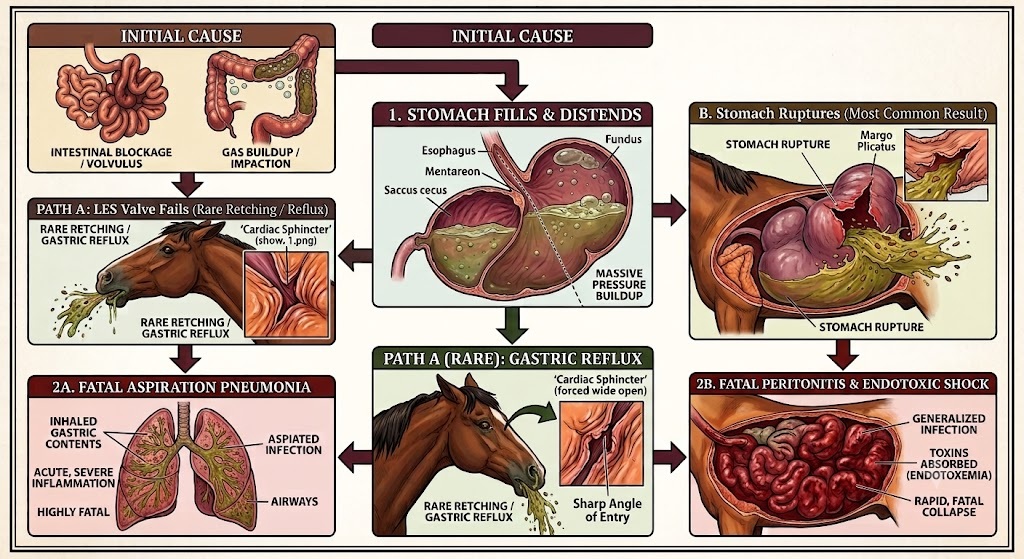
Cascading pathways of acute gastric distention.(PATH A) Gastric distention triggers the gastric reflex, forcing the lower esophageal sphincter (LES) open and leading to emesis and secondary aspiration pneumonia as shown in (2A). (PATH B) More commonly, severe intragastric pressure leads to gastric rupture, culminating in fatal peritonitis and endotoxic shock (2B).
What Should You Do If Your Horse Appears to Be Vomiting?
If your horse appears to be vomiting, don’t assume it’s a simple stomach upset. Whether the material is coming from the esophagus (such as with choke) or, in the rarest cases, from the stomach, your horse should be treated as a veterinary emergency until proven otherwise.
1. Contact Your Veterinarian Immediately
Feed, saliva, or fluid coming from the mouth or nostrils is not normal in horses. Early veterinary assessment is essential because conditions such as choke, severe colic, or gastric reflux can worsen rapidly.
2. Remove Feed Immediately
Take away hay, grain, and treats to prevent additional material from entering the esophagus or stomach. Unless your veterinarian advises otherwise, avoid offering more feed until your horse has been examined.
3. Keep Your Horse Calm
Minimize stress and avoid unnecessary movement. If your horse is showing signs of colic, follow your veterinarian’s instructions regarding walking or confinement rather than forcing exercise.
4. Don’t Try to Treat It Yourself
Do not attempt to pass a hose or tube down your horse’s throat or give medications unless directed by your veterinarian. Improper treatment can worsen an esophageal obstruction or increase the risk of aspiration.
5. Watch for Other Warning Signs
While waiting for your veterinarian, note any additional symptoms, including:
- Feed or saliva draining from the nostrils
- Repeated swallowing or coughing
- Neck stretching or repeated attempts to swallow
- Severe abdominal pain, rolling, or pawing
- Heavy sweating or signs of shock
These observations can help your veterinarian determine whether the problem is more consistent with choke, severe colic, gastric reflux, or another emergency.
How Veterinarians Diagnose the Cause
Because horses cannot normally vomit, a veterinarian’s first priority is determining where the material is coming from. Feed and saliva draining from the nostrils usually point toward an esophageal problem such as choke, whereas fluid originating from the stomach may indicate gastric reflux or another life-threatening gastrointestinal emergency.
The diagnostic process typically includes:
Physical Examination
Your veterinarian will begin with a thorough physical examination, checking your horse’s heart rate, temperature, hydration, abdominal sounds, and signs of pain. They’ll also ask when the problem started, what your horse was eating, and whether colic signs developed before the episode.
Passing a Nasogastric Tube
A nasogastric tube is one of the most valuable diagnostic tools in horses with suspected choke or severe colic. If an esophageal obstruction is present, the tube may identify where the blockage is located. If large volumes of fluid are recovered from the stomach, it suggests gastric reflux, indicating that digestive contents are not moving normally through the intestines.
Endoscopy
If choke is suspected or the esophagus may have been damaged, your veterinarian may perform an endoscopic examination. A flexible camera allows direct visualization of the esophagus to identify obstructions, inflammation, ulcers, or injuries that are not visible during a routine examination.
Additional Tests
Depending on your horse’s condition, further diagnostics such as blood tests, abdominal ultrasound, or abdominal fluid analysis may be recommended to evaluate severe colic, intestinal obstruction, infection, or other underlying diseases.
Identifying the source of the problem is critical because a horse that appears to be vomiting may require very different treatment depending on whether the disease involves the esophagus, stomach, or intestines.
Treatment Depends on the Underlying Cause
There is no single treatment for a horse that appears to be vomiting. Management depends entirely on the underlying cause, which is why an accurate diagnosis is essential before treatment begins. The following overview reflects current recommendations from the American Association of Equine Practitioners (AAEP) and the Merck Veterinary Manual. The original references are provided in the Sources section below.
| Condition | Typical Treatment |
|---|---|
| Choke | Sedation, esophageal lavage (flushing the blockage), anti-inflammatory medication, supportive care, and antibiotics if aspiration pneumonia develops. |
| Gastric Reflux | Gastric decompression with a nasogastric tube, intravenous fluids, pain management, and treatment of the underlying intestinal disease. |
| Severe Colic or Intestinal Obstruction | Medical management for appropriate cases or emergency surgery for strangulating obstructions, volvulus, impactions, or other surgical lesions. |
| Aspiration Pneumonia | Antibiotics, anti-inflammatory medication, supportive care, and hospitalization for severe cases. |
Early treatment greatly improves the chances of a successful outcome, particularly for choke, which often resolves without long-term complications when treated promptly. In contrast, conditions associated with gastric reflux or true vomiting usually indicate severe gastrointestinal disease and require immediate veterinary intervention. Delaying treatment increases the risk of life-threatening complications such as gastric rupture, peritonitis, or endotoxic shock.
Never attempt to treat a horse that appears to be vomiting without veterinary guidance. What looks like a simple obstruction may actually be a rapidly progressing gastrointestinal emergency, and treatments that are appropriate for one condition may be harmful for another.
Can These Emergencies Be Prevented?
While not every case can be prevented, good feeding and management practices can reduce the risk of choke, certain forms of colic, and other digestive disorders that may cause a horse to appear to be vomiting. Choosing appropriate treats is part of good feeding management. For example, if an owner wants to offer celery as a treat, it should be chopped or diced before feeding to horses to reduce the risk of choking and make it easier for the horse to eat. The following recommendations reflect current guidance from the American Association of Equine Practitioners (AAEP) and the Merck Veterinary Manual. See the Sources section below for the original references.
- Soak feeds that expand with water, such as beet pulp, according to the manufacturer’s instructions.
- Introduce dietary changes gradually to give the digestive system and gut microbes time to adapt. Certain vegetables, including broccoli, cabbage and cauliflower, can also increase intestinal gas and are generally not recommended as treats for horses. Learn whether horses can safely eat broccoli, cabbage or cauliflower.
- Provide unlimited access to clean, fresh water to help reduce the risk of dehydration and impaction colic.
- Feed smaller, more frequent meals rather than large grain meals whenever possible.
- Schedule regular dental examinations, as poor dentition can interfere with chewing and increase the risk of choke.
- Maintain an effective parasite control program based on your veterinarian’s recommendations, particularly for young horses.
- Monitor horses closely after abdominal surgery, since post-operative ileus and gastric reflux require early recognition and treatment.
- Learn the early signs of choke and colic and contact your veterinarian promptly rather than waiting to see if the problem resolves on its own.
Although these measures cannot eliminate every emergency, they can help reduce the risk of serious digestive disease and improve the chances of a successful outcome through early recognition and prompt veterinary care.
FAQs About Puking in Horses
What happens if a horse needs to throw up?
Healthy horses cannot vomit to relieve pressure inside the stomach. If excessive gas or fluid builds up because of severe colic, an intestinal obstruction, or gastric reflux, the stomach continues to distend instead of emptying itself. This is a veterinary emergency. Your veterinarian will often pass a nasogastric tube through the horse’s nostril into the stomach to remove accumulated fluid and gas (gastric decompression), helping relieve pressure while identifying the underlying cause. If the pressure cannot be relieved or a surgical condition is present, emergency surgery may be required. Without prompt treatment, the stomach can rupture, resulting in life-threatening peritonitis and endotoxic shock.
Can horses burp?
Not effectively. The same anatomical features that prevent horses from vomiting also make it difficult for gas to move back through the esophagus. Instead, gas normally continues through the intestines. If gas becomes trapped because of severe colic or an intestinal obstruction, horses cannot simply burp or vomit to relieve the pressure, making prompt veterinary evaluation essential.
Can a horse survive after vomiting?
It depends on the underlying cause. Most horses that appear to be vomiting are actually experiencing choke, and the prognosis is generally good when treated promptly. However, true vomiting is extremely rare and usually indicates severe gastrointestinal disease, such as gastric rupture or advanced intestinal obstruction. These conditions are life-threatening and require immediate veterinary treatment.
Can gassy foods cause a horse to vomit?
No. Because horses have a specialized cardiac sphincter that prevents them from vomiting, trapped gas or fermentation from certain gassy foods cannot be expelled through the mouth. Instead, it leads to severe colic, abdominal distension, and extreme discomfort. To ensure you are only feeding items that support safe digestion, review our complete guide on what horses can eat.
Why is feed coming out of my horse’s nose?
The most common cause is choke, where food becomes lodged in the esophagus instead of reaching the stomach. Saliva and partially chewed feed then back up and drain from the nostrils or mouth, making it look as though the horse is vomiting. A veterinarian can usually confirm the diagnosis by passing a nasogastric tube or performing an endoscopic examination and provide appropriate treatment.