
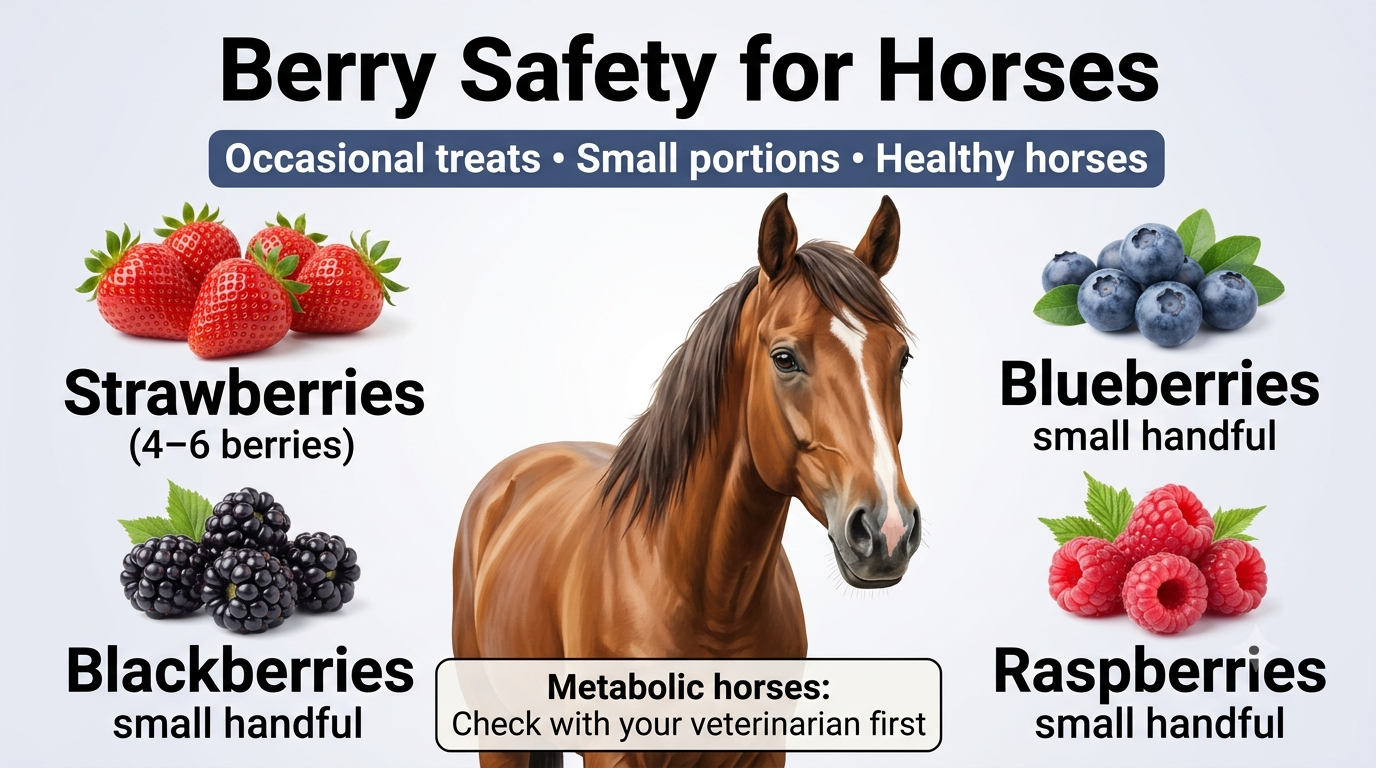
Yes, horses can eat blueberries, strawberries, raspberries, and blackberries as occasional treats. A small handful of any of these berries a few times a week is fine for most healthy horses.
The exception is horses with Equine Metabolic Syndrome, insulin dysregulation, or a history of laminitis. For these horses, even natural fruit sugar can trigger a dangerous insulin spike, so berries should be avoided or cleared with a vet first.
Berries are having a moment in the horse world. I get asked about them almost weekly now, usually by an owner who saw a video of a horse enjoying strawberries or blueberries and wants to know if it is safe to try.
The good news is that most berries really are safe. The catch is that safe does not mean unlimited, and it definitely does not mean berries are a metabolic treatment.
Below, I break down each berry individually, cover realistic portion sizes, and give you the honest version of what the science actually supports and what it does not. For a broader guide to safe treats, see our what horses can eat guide.
Quick Reference: Berry Safety At A Glance
| Berry | Safe? | Typical Portion | Main Watch Out |
|---|---|---|---|
| Blueberries | Yes | 1 small handful, 2 to 3x weekly | Sugar content in overweight horses |
| Strawberries | Yes | 4 to 6 berries, a few times weekly | Wash well, remove leafy caps |
| Raspberries | Yes | 1 small handful | Wild canes have thorns |
| Blackberries | Yes | 1 small handful | Wild canes have thorns |
Can Horses Eat Blueberries?
Yes. Blueberries are one of the gentlest fruits you can offer a horse.They are small, soft, and low in calories compared to most other treats.
Why owners like them:
- Naturally sweet, so most horses accept them right away
- Small size means low choking risk even for older horses
- Easy to portion into a bucket or feed as a hand treat
Nutritional snapshot:
- Contain vitamin C and vitamin K
- High in anthocyanins, the plant pigments responsible for their antioxidant reputation
- Relatively low in sugar compared to grapes or bananas, though not sugar free
Safe portion:
A small handful, roughly a quarter cup, two or three times a week is a reasonable ceiling for a healthy adult horse.
Safety notes:
- Fresh or frozen both work. If frozen, let them thaw slightly so they are not rock hard on the teeth.
- Rinse to remove any pesticide residue or field dust.
- Skip blueberry juice or dried blueberries with added sugar. These concentrate the sugar load in a way whole fresh berries do not.
Like berries, other fruits can be fed as occasional treats, but their sugar content and feeding considerations vary; oranges are one example.
Can Horses Eat Strawberries?
Yes, horses can eat strawberries safely in moderation. They are another low risk treat, and their soft texture makes them easy on older horses with dental issues.
Why owners like them:
- Soft flesh, easy to chew and swallow
- Strong smell and flavor horses tend to find appealing
- Widely available and inexpensive
Nutritional snapshot:
- Good source of vitamin C, though horses already synthesize their own
- Contain fiber and water, which support hydration
- One cup of sliced strawberries carries roughly 7 grams of sugar, a moderate amount as fruits go
Safe portion:
Four to six medium strawberries, offered a few times a week, is a sensible upper limit. Smaller ponies should stay closer to one or two.
Safety notes:
- Wash thoroughly. Strawberries are grown low to the ground and pick up more dirt, pesticide residue, and mold spores than tree fruit.
- Cut larger berries in half or quarters for greedy eaters prone to bolting treats.
- Discard any berry that is soft, moldy, or bruised. Horses are sensitive to mycotoxins from spoiled produce.
- The green leafy cap is not toxic in small amounts, but it is fibrous and offers no benefit, so most owners remove it.
Can Horses Eat Raspberries?
Yes. Raspberries are safe and, if anything, slightly lower in sugar than strawberries.
Why owners like them:
- Tart flavor many horses find novel and enjoyable
- Naturally lower sugar profile among common berries
- Good source of fiber thanks to their seedy texture
Nutritional snapshot:
- Rich in vitamin C and manganese
- High in antioxidant compounds, similar to blueberries
- Fiber content is notably higher than most fruit treats
Safe portion:
A small handful, similar to blueberries, is plenty. Raspberries are light, so this is a small amount by weight.
Safety notes:
- If you are foraging wild raspberries along a trail or property line, inspect the canes first. Raspberry canes are covered in sharp thorns, and horses grazing carelessly near a bramble patch can injure their lips, gums, or tongue on the thorny stems.
- Never let a horse graze directly on a raspberry patch unsupervised. Pick the fruit and hand feed it instead.
- Store bought raspberries mold quickly. Check every berry before feeding, since moldy fruit can cause digestive upset.
Can Horses Eat Blackberries?
Yes. Blackberries share almost the same safety profile as raspberries, with a slightly sweeter, less tart flavor.
Why owners like them:
- Sweet tart flavor that pairs well mixed with other berries
- Good vitamin and mineral content
- Widely grown wild in many regions, making them a common trailside find
Nutritional snapshot:
- High in vitamin C, vitamin K, and manganese
- Similar antioxidant profile to blackberries’ bramble cousin, the raspberry
- Contain more fiber than sugar by comparison to something like a grape
Safe portion:
A small handful, the same guideline as raspberries.
Safety notes:
- This is the big one: blackberry canes have thick, sharp thorns, often sharper and more numerous than raspberry canes. A horse pushing its face into a wild blackberry bramble to reach fruit risks puncture wounds to the lips, muzzle, and gums.
- If blackberries grow along your fence line or trail, either clear the canes back or plan to hand pick the fruit yourself rather than letting your horse browse the patch.
- Wash cultivated blackberries the same way you would strawberries, since they grow close to the ground and collect debris.
The Reality Check: Do Berries Actually Help Metabolic Horses?
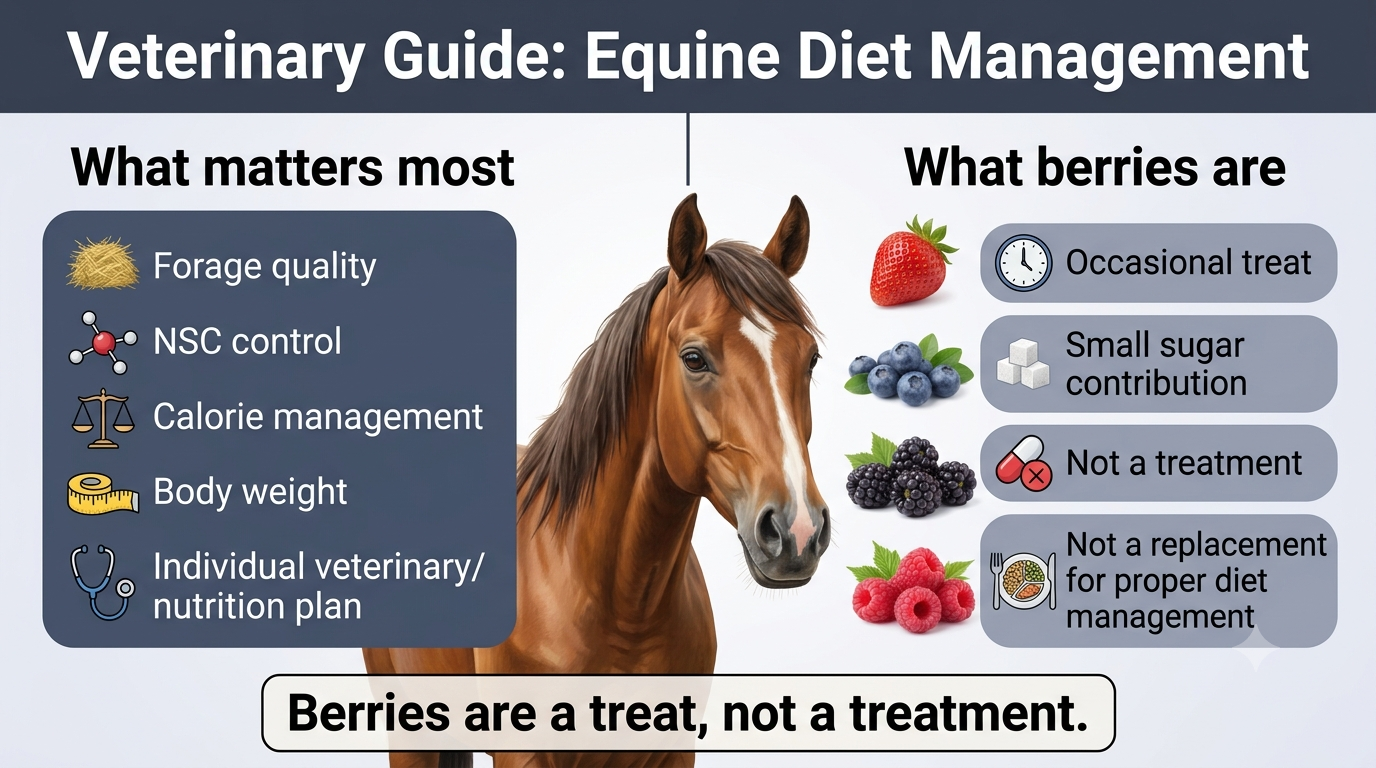
Berries get plenty of attention for their antioxidants, but I would be cautious about giving them a metabolic benefit that has not been proven in horses.
What we know:
- Most research on berry polyphenols and antioxidants comes from humans and rodents, not horses
- Horses process these compounds differently as hindgut fermenters
- There is no good equine evidence that whole berries treat or improve Equine Metabolic Syndrome
That does not make berries a bad treat. It simply means their potential metabolic benefits should not distract from what actually matters.
For metabolic horses, focus on:
- Forage NSC around 10 to 12 percent or lower
- Soaking hay when testing shows high sugar and starch
- Careful pasture, calorie, and body weight management
- Forage testing and an individualized feeding plan
Kentucky Equine Research also notes that horses with insulin dysregulation may tolerate considerably less sugar and starch per meal than healthy horses. That is why I would put far more weight on the overall ration than on any single fruit. For owners who still want to offer a treat while keeping sugar intake lower, celery can be a practical alternative to fruit.
The Antioxidant Myth: Why More Isn’t Always Better
Here is a myth I hear constantly in the barn aisle: if a little antioxidant is good, then a mountain of fruit must be even better.
It is not that simple.
The myth: Antioxidants are sometimes treated like miracle molecules that fight inflammation, reverse aging, and correct metabolic disease.
The reality:
- Not a magic bullet: Berry antioxidants such as anthocyanins can help neutralize free radicals produced during normal cellular stress. They cannot correct insulin dysregulation, obesity, or a forage program that is too high in sugar.
- The body already has its own system: Horses have a built in antioxidant system, including glutathione peroxidase, which depends on nutrients such as selenium. I would not expect extra antioxidants from fruit to fix an unbalanced diet.
- Some antioxidants matter more clinically: When I am concerned about antioxidant status, I pay more attention to vitamin E, especially in horses without fresh pasture, along with properly balanced selenium, zinc, and copper.
Berries can still be a perfectly reasonable treat. I just would not use them to compensate for problems elsewhere in the diet.
If you are concerned about oxidative stress or possible vitamin E deficiency, that is a conversation for bloodwork and proper ration balance, not a fruit bowl.
Who Should Skip Berries Entirely?
- Horses currently diagnosed with Equine Metabolic Syndrome or insulin dysregulation, unless your vet has specifically cleared small amounts
- Horses with active or recent laminitis
- Horses with PPID (Cushing’s) that also have confirmed insulin dysregulation
- Any horse with a known fruit allergy or a history of hives, swelling, or GI upset after eating fruit
- Horses on a strict low sugar diet prescribed by a veterinarian for any other condition
If you are unsure where your horse falls, a simple blood insulin test through your vet is far more useful than guessing.
General Feeding Tips For Any Berry
- Always introduce a new berry slowly, starting with just one or two pieces
- Wash all berries thoroughly, even organic ones
- Skip anything moldy, fermented, or overripe
- Treat berries as a small percentage of overall daily calories, not a meal replacement
- Watch wild bramble patches for thorns before letting a horse graze near them
- When in doubt about a specific horse’s health status, ask your vet before adding any new treat
Berries are generally safe in moderation, but horses should never be given certain foods that can cause poisoning or serious illness. See our foods horses should never eat guide for the major toxic and dangerous foods.
FAQs About Can Horses Have Blueberries, Strawberries, Blackberries & Raspberries?
Can horses eat berries every day?
Occasional feeding is safer than daily feeding. A few times a week keeps total sugar intake reasonable for most healthy horses.
Are frozen berries okay?
Yes, frozen blueberries, strawberries, raspberries, and blackberries are all fine once slightly thawed. Avoid feeding them rock solid, since that can be tough on teeth.
Can miniature horses and ponies eat berries?
Yes, but portion sizes should be smaller given their lower body weight and often higher risk of insulin dysregulation as a breed group.
Do berry leaves or stems need to be removed?
Strawberry caps are not toxic in small amounts, though most owners remove them out of habit. Raspberry and blackberry canes should never be fed, since the thorny stems pose an injury risk.