
Key Takeaways
- Yes, healthy horses can eat oranges as an occasional treat.
- A few small segments at a time is plenty; I don’t recommend making oranges a daily treat.
- Oranges are safe, not toxic for horses, unlike the foods covered in our do-not-feed list.
- Oranges aren’t a useful vitamin C supplement for healthy horses because horses normally make their own vitamin C.
- Cut oranges into manageable pieces to reduce the risk of choke, and wash them before feeding.
- Use more caution with metabolic disease, HYPP, or active gastric ulcers, where oranges may not be an appropriate treat.
I get some version of this question at least once a month, usually from a boarder standing at the stall door with an orange in hand and a guilty look on their face. The answer depends on how much, how it’s prepared, and whether your horse has any underlying conditions I’d want to know about first.
Here’s how I break it down for clients.
Can Horses Eat Oranges?
Yes. Most healthy horses can eat small amounts of fresh orange as an occasional treat. A few orange segments, a couple of times a week, is a non issue for the average healthy horse. What gets horses into trouble isn’t the orange itself. It’s owners who don’t think about portion size, don’t remove the seeds, or hand over a whole fruit at once without cutting it into manageable pieces.
I treat oranges the same way I treat apples, strawberries or carrots in a feeding plan: fine as a treat, not something I’d ever build a diet around.
What’s Actually in an Orange (and Why It Matters for Horses)
| Component | What It Means for Your Horse |
|---|---|
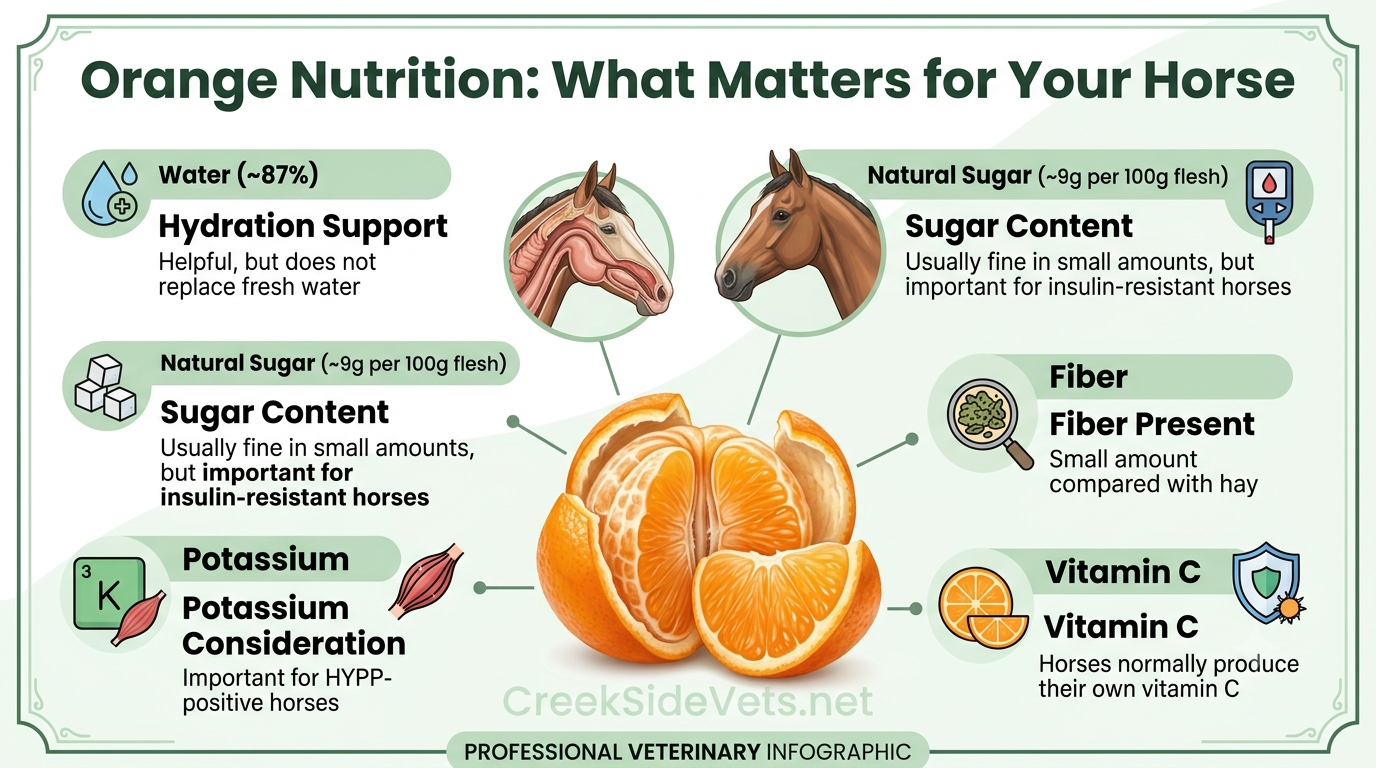
| Water (~87%) | Hydrating, but doesn’t substitute for a clean water source |
| Sugar (~9g per 100g flesh) | Moderate. Enough that I factor it in for insulin resistant or laminitic horses |
| Fiber | Present in the pulp and membrane, but nowhere near what your horse gets from hay |
| Potassium (~180mg per 100g) | Worth knowing about if you own an HYPP-positive horse, more on that below |
| Vitamin C | Horses synthesize their own via the liver. This is the one I correct the most |
That vitamin C point is worth pausing on because I hear it often: “I’m giving her an orange for the vitamin C.” Unlike humans, healthy horses can produce vitamin C themselves, so they generally don’t need it from their diet.
Research has explored supplementation mainly during periods of stress, such as prolonged transport, rather than as a routine nutritional requirement.
So if that’s your reason for offering oranges, it’s not doing what you think it’s doing.
Portion Size: What I Actually Recommend
I don’t like giving a single blanket number because it depends on the horse’s size, workload, and metabolic status. But as a general starting point, I tell clients:
- A few small segments (roughly a quarter to half of one orange) at a time is plenty.
- Keep total treats, oranges included, under about 10% of the daily diet. For most horses that’s not a hard limit you’ll ever approach with fruit. It’s more a reminder that treats shouldn’t be crowding out forage.
- Two to three times a week is a reasonable frequency for a healthy horse with no metabolic concerns. This isn’t a food I recommend feeding daily.
If you’ve got a horse in hard work or one that’s underweight, occasional oranges aren’t something I worry about. If you’ve got an easy keeper or a horse I’m already watching for insulin resistance, I’d rather you skip it or keep portions very small. More on that below.
How to Prepare Oranges for Horses
Almost every complication I’ve seen from horses and fruit, oranges included, traces back to preparation, not the fruit itself.
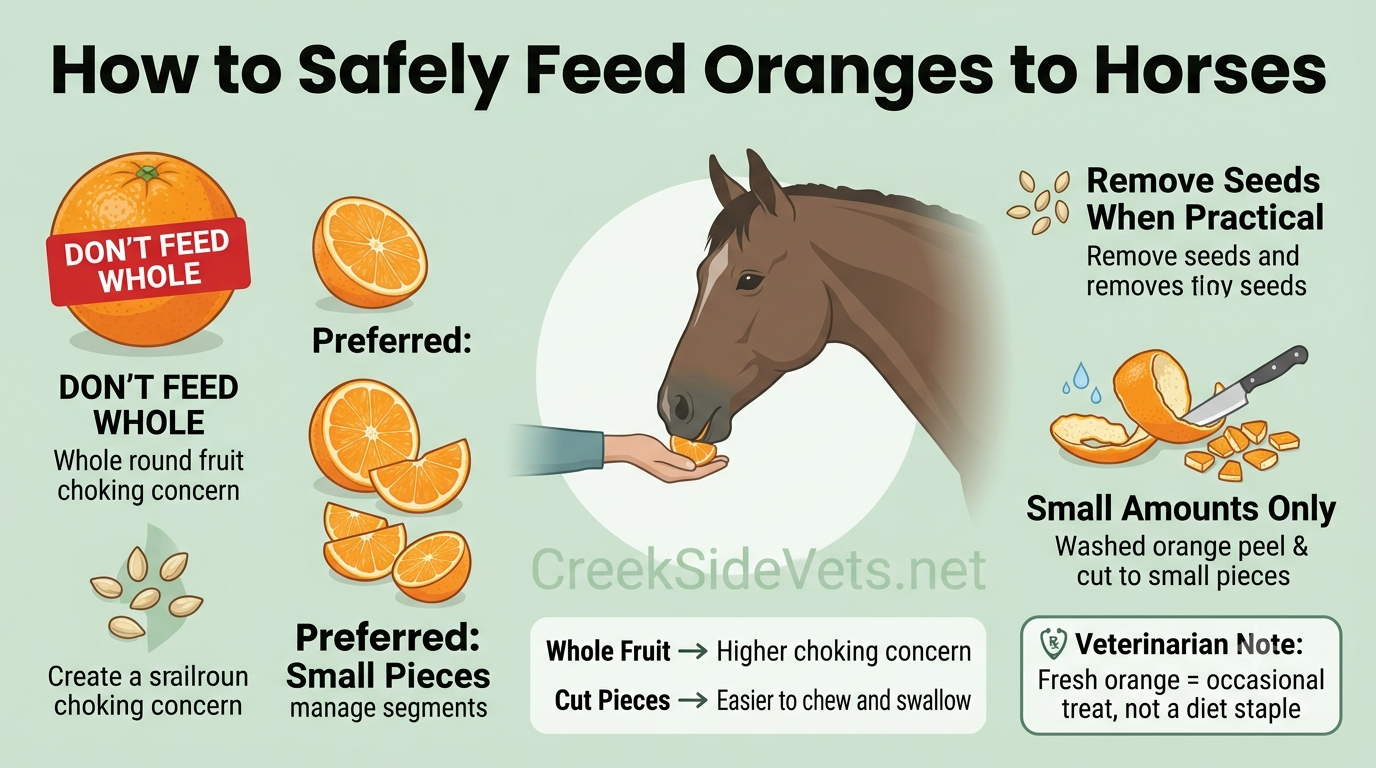
- Wash it. Pesticide residue on the peel is a legitimate, if minor, consideration.
- Remove seeds where practical. A swallowed seed here and there isn’t something I’d expect to cause a problem, but there’s no reason to leave them in.
- Cut it into sections or slices. Never hand over a whole orange. This is the one I’m strictest about.
- Introduce gradually. Any new food, even a friendly one, warrants watching your horse’s reaction the first couple of times.
A horse’s hindgut also needs time to adapt to dietary changes. A large serving of orange introduces considerably more sugar at once than a few segments, which can contribute to loose manure or mild digestive upset. It’s avoidable, so I’d rather start small.
The peel itself isn’t toxic and can be offered in small, washed pieces if your horse will eat it. Some do; some won’t touch it. Either way, keep the pieces manageable.
Veterinary studies of esophageal obstruction remind me why I’m strict about cutting fruit into manageable pieces. Horses can’t vomit or bring swallowed food back up, so when a poorly chewed piece becomes lodged in the esophagus, it can remain there. I’ve treated choke cases from owners feeding whole apples and carrots that weren’t sectioned. Citrus is no different. A few seconds of preparation is worth the effort.
When I Tell Owners to Avoid Oranges
A few groups I’m more cautious with.
Horses with Equine Metabolic Syndrome (EMS) or insulin dysregulation: The sugar in oranges isn’t enormous, but when I’m already managing a horse’s non-structural carbohydrate (NSC) intake, I’d rather use a lower-sugar treat such as chopped celery than fruit. One orange segment isn’t going to trigger a crisis, but I want these horses’ NSC exposure to stay consistent, treats included.
When managing horses with insulin dysregulation (ID) or Equine Metabolic Syndrome (EMS), current ECEIM consensus guidelines recommend choosing forage with NSC below 10%. That target is important when managing the overall diet, which is why I also count the small extras. For a metabolic horse, I want treats to fit the same predictable, low-NSC approach as the rest of the diet.
Horses with a history of laminitis, or PPID (Cushing’s) with poor insulin control: Same logic. I’m not trying to eliminate every pleasure in these horses’ lives. I just want their sugar sources managed deliberately rather than casually.
HYPP positive horses: This one gets overlooked because owners are usually watching sugar and forget about potassium. Oranges are relatively high in potassium. These horses require careful dietary potassium management, so I’d stick with the feeding plan already established by your veterinarian.
Horses currently being treated for gastric ulcers: Citrus fruit carries a fair amount of citric acid. A tiny piece isn’t going to cause ulcers in a healthy horse, but if a horse is actively being treated for Equine Gastric Ulcer Syndrome, I would recommend avoiding oranges until treatment is complete.
For every other healthy horse, good bodyweight, no metabolic diagnosis, normal insulin, an orange is a genuinely low risk treat.
Can Horses Eat Clementines, Mandarins, Orange Juice & Dried Orange?
I get asked about these almost as often as the original question, so it’s worth breaking them out separately.
Clementines and mandarins: These are usually my first suggestion when owners want something easy. They’re naturally seedless and peel apart into segments, which reduces the two biggest concerns: seeds and whole-fruit choke risk. The same portion guidance applies.
Orange juice: This is a pass in my book. Commercial juice concentrates the sugar and removes much of the fiber, and some products have added sugar. There’s no real advantage over a fresh orange segment, especially for a metabolically sensitive horse.
Dried orange: Same problem in a smaller package. Drying concentrates the sugar, so a small-looking handful can contain a surprising amount. I’d treat dried citrus more like candy than fruit and keep it out of the regular treat rotation.
FAQs About Can Horses Have Oranges?
Can Horses Eat Orange Peel?
Yes, in small amounts. Orange peel isn’t toxic to horses and contains some antioxidants, although some horses don’t like the taste and will leave it behind. If you do offer it, wash the peel first to remove dirt and pesticide residue, and cut it into small, manageable pieces rather than feeding a long strip or whole peel. The main concern isn’t toxicity; it’s making sure the peel is easy for the horse to chew and swallow without creating an avoidable choke risk.
Can Horses Eat Orange Seeds?
I recommend removing the seeds when you can. If a horse accidentally swallows an occasional small seed, I wouldn’t expect that alone to cause a problem, so I don’t want owners panicking over a seed they missed. But there’s no nutritional benefit to feeding them, and removing them takes very little effort. When I’m preparing fruit for a horse, I prefer to take out the seeds and cut everything into pieces that are easy to chew and swallow.
Can Horses Have Frozen Oranges as a Treat?
This isn’t something I bring up unless owners ask about enrichment, but it’s a good one. Freezing a few orange slices, or clean peel, into a stock tank or water bucket gives stalled or bored horses something to investigate and can encourage them to drink more in hot weather. Keep portions small, the same rules about metabolic status still apply, but as a low stakes summer enrichment idea it works well and horses generally enjoy it.
Can Horses Eat Oranges Every Day?
I wouldn’t make oranges a daily treat. A few segments a couple of times a week is plenty for most healthy horses, and there’s no nutritional reason a horse needs orange every day. If an owner is giving fruit frequently, I’d rather look at the horse’s total treat intake than focus on one particular fruit. Treats should stay a small part of the diet, with forage doing the heavy lifting nutritionally.
Can Foals Eat Oranges?
I don’t see a reason to make oranges part of a foal’s regular diet. Young foals have more important nutritional priorities while they’re growing, and fruit doesn’t add anything they need that should take precedence over a properly balanced diet. Once a foal is eating solid feed reliably, a very small piece of orange isn’t something I’d expect to cause trouble in an otherwise healthy youngster, but I’d introduce any new treat gradually rather than handing over a whole piece of fruit.
Can Senior Horses Eat Oranges?
Yes, most healthy senior horses can have small amounts of orange, but I pay more attention to preparation as they get older. If a horse has worn teeth or difficulty chewing, I’d cut the segments into smaller, manageable pieces rather than offering larger pieces of fruit. I also look at the individual horse’s diet and health status. A senior horse with insulin dysregulation, PPID, poor body condition, or dental problems may need a different approach to treats than a healthy older horse with good teeth and normal metabolic health. An occasional orange isn’t going to determine how long your horse lives, but consistently poor nutrition and unmanaged health problems can affect long-term health and longevity.