
Many owners wonder how their horse’s age compares to human years. There is no scientifically validated formula that converts horse years into exact human years because horses mature rapidly during their early years and age differently throughout adulthood.
This calculator uses approximate life-stage comparisons based on equine development and aging.
Horse Years to Human Years Calculator
Use this horse age calculator to estimate your horse’s approximate human-age equivalent and understand their current life stage. The result is based on common patterns of equine development rather than a fixed conversion formula.
Horse Age Calculator
Horse Age Calculator
Enter a whole number between 1 and 30.
There is no scientifically validated method for converting horse years into exact human years. The ages shown in this calculator are approximate life-stage comparisons based on equine growth, maturity, and aging patterns. They are intended for educational purposes and should not be interpreted as exact biological equivalents.
How the Calculator Interprets Horse Age
The calculator compares a horse’s chronological age with similar stages of human development. The comparison changes depending on the horse’s age because horses do not mature at the same rate throughout life.
A young horse experiences major developmental changes in a short period. Growth, training readiness, skeletal development, and behavioural maturity progress quickly during the early years.
After maturity, the conversion becomes slower. Adult horses generally spend many years in a stable stage of life, so each additional year represents a smaller change compared with young horses.
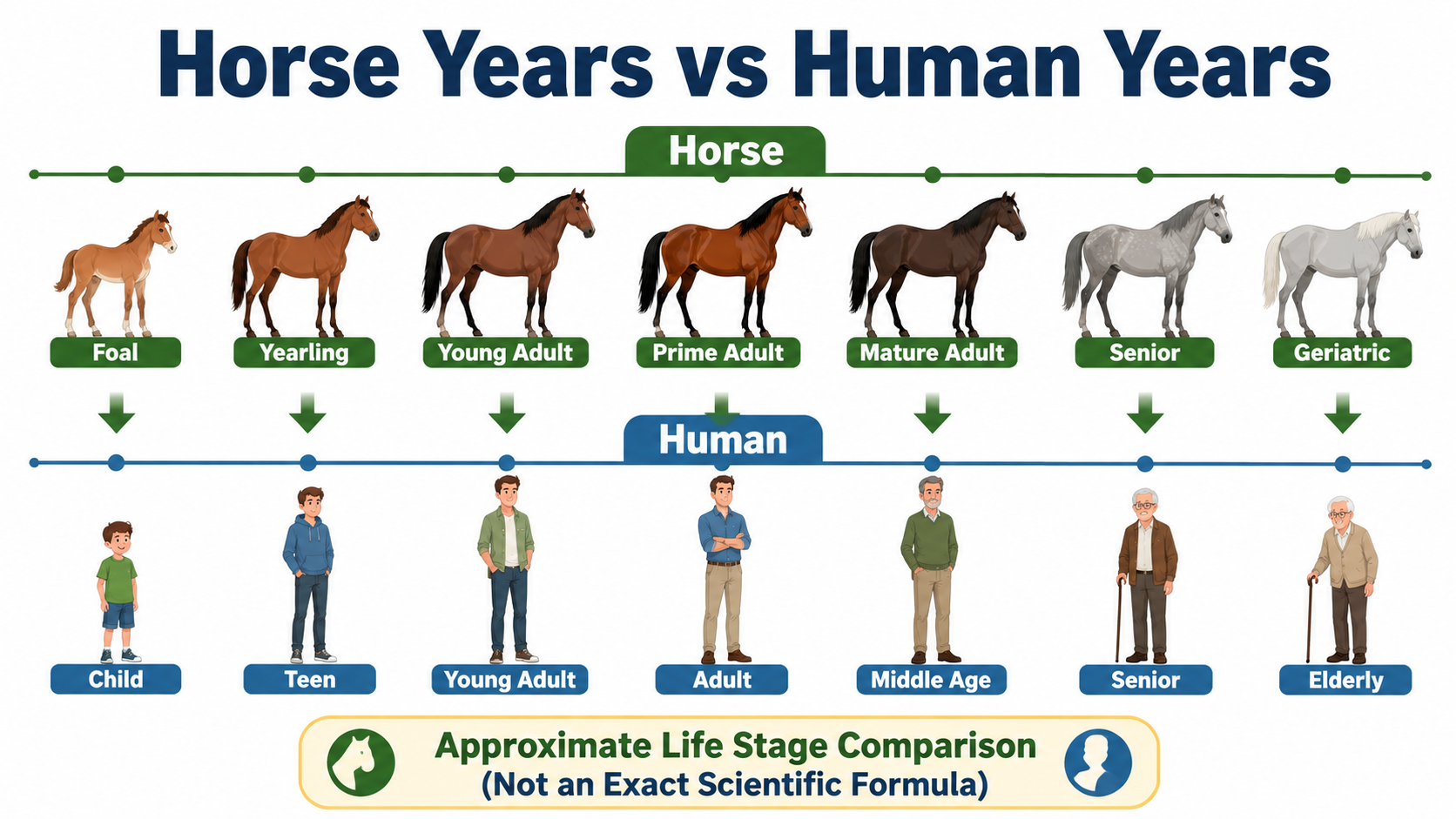
A visual guide comparing horse life stages with human life stages. This approximate comparison helps horse owners understand how horses mature and age compared to people.
Horse Age to Human Age Chart
A horse age chart helps translate equine age into a familiar human life stage. The comparison is not based on a strict mathematical formula because horses experience the largest developmental changes early in life.
| Horse Age | Approximate Human Age | Life Stage |
|---|---|---|
| 1 year | Around 6–8 years | Yearling |
| 2 years | Around 12–14 years | Adolescent |
| 3 years | Around 17–19 years | Young Adult |
| 4 years | Around 20–22 years | Early Adult |
| 5 years | Around 24–26 years | Prime Adult |
| 10 years | Around 35–40 years | Prime Adult |
| 15 years | Around 45–50 years | Mature Adult |
| 20 years | Around 60 years | Senior Horse |
| 25 years | Around 70 years | Advanced Senior |
| 30 years | Around 80+ years | Geriatric Horse |
How Is Horse Age Converted to Human Years?
Horse age conversion is based on developmental stages, not a universal formula. The reason the comparison changes over time is that a horse’s body does not age at the same speed from birth through old age.
Rapid Early Development
The first few years create the largest difference between horse age and human age. Young horses experience major changes in growth, coordination, learning, and physical development within a short period. Those early developmental changes begin long before birth. If you’re interested in pregnancy and foal development, read our guide on horse gestation and normal pregnancy length.
Dental development and skeletal maturity are also important markers during this stage. Permanent incisors begin appearing between roughly 2.5 and 5 years of age, while the skeleton continues developing toward full maturity.
Adult Stability and Slower Aging
After reaching maturity, horses enter a longer adult stage where physical changes happen more gradually.
Senior Physiological Changes
As horses move into their senior years, aging becomes more individual. Changes in muscle maintenance, metabolism, recovery, and dental function may appear at different times depending on the horse.
Why Horse Years Aren’t Like Dog Years
Many owners are familiar with the idea that one dog year equals seven human years and wonder if horses follow the same pattern. They do not.
Horses, dogs, and humans have different growth rates, body development, and aging patterns.
Dogs and horses experience different maturity timelines. Horses have a rapid developmental period during their first years and a longer adult stage where aging happens more gradually.
Horse age calculators use life stages instead of a fixed multiplier because they better reflect equine development.
Horse Age Examples
5-Year-Old Horse: Similar to a Young Adult
A 5-year-old horse is approximately comparable to a young adult human. By this age, many horses have reached skeletal maturity and developed the strength, coordination, and experience needed for regular work. Understanding how much weight your horse can safely carry is also essential when evaluating if they are ready for their workload.
10-Year-Old Horse: Similar to a Mature Adult
A 10-year-old horse is often compared to a mature adult human. Many horses at this age are physically developed and established in their training.
20-Year-Old Horse: Similar to a Senior Adult
A 20-year-old horse is approximately comparable to a senior human. Many horses remain active, but owners may pay closer attention to movement, body condition, and comfort.
30-Year-Old Horse: Similar to an Elderly Human
A 30-year-old horse represents an advanced stage of life and is comparable to an elderly human.
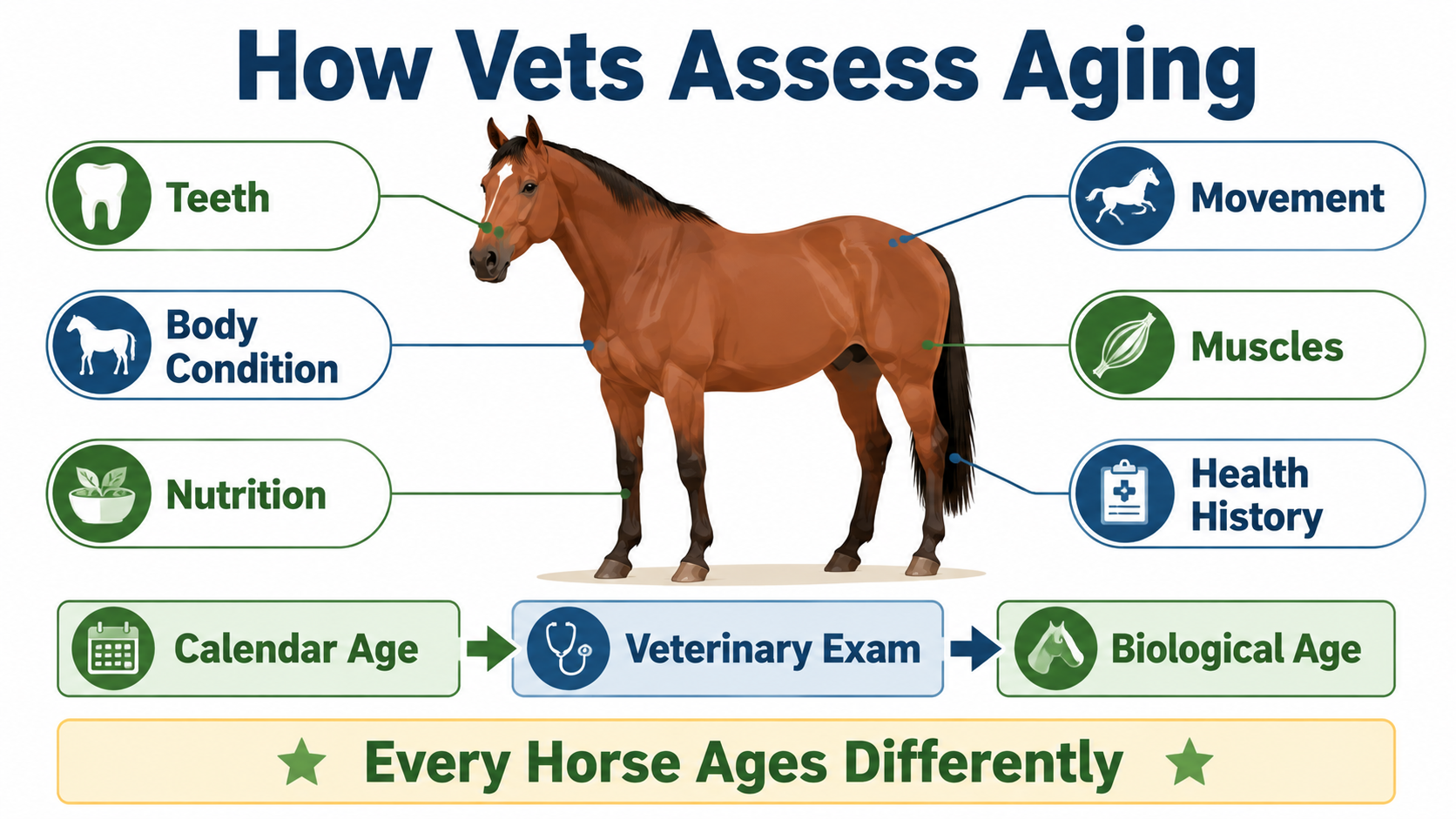
Veterinarians evaluate more than a horse’s calendar age. This infographic highlights the key factors used to understand a horse’s biological age and overall aging process.
Why Horse Years to Human Years Are Only an Estimate
A horse age calculator provides a useful comparison, but it cannot measure a horse’s exact biological age. Two horses of the same chronological age can age differently depending on their genetics, environment, and life history. While this calculator compares life stages, it should not be confused with a horse’s expected longevity. Learn more about the average horse lifespan and the factors that influence how long horses live.
Factors That Influence Biological Aging
Breed: Different breeds have different body structures, metabolic demands, and inherited traits.
Genetics: Genetic traits influence health, durability, and aging.
Nutrition: Diet and forage quality support healthy body condition throughout life. Choosing safe treats and avoiding harmful foods also contributes to long-term health.
Health history: Injuries, illnesses, and dental issues affect aging.
Workload: Physical demands influence long-term soundness.
Veterinarians evaluate the whole horse by considering age alongside body condition, movement, dental health, and physical function. Monitoring a healthy average horse weight is also a key indicator of your horse’s overall wellness throughout these life stages.
FAQs About Horse Years to Human Years
Is one horse year equal to seven human years?
No. The seven-year rule used for dogs does not apply to horses because horses have different growth and aging patterns.
How old is a 20-year-old horse in human years?
A 20-year-old horse is approximately equivalent to an 84-year-old human.
How old is a 30-year-old horse?
A 30-year-old horse is approximately equivalent to an elderly human in their 120s.
Do ponies age differently from horses?
Ponies generally follow a similar aging pattern but often have longer lifespans than many larger horse breeds.
Can a horse age calculator tell my horse’s exact human age?
No. It provides an approximate life-stage comparison, not an exact biological conversion.